
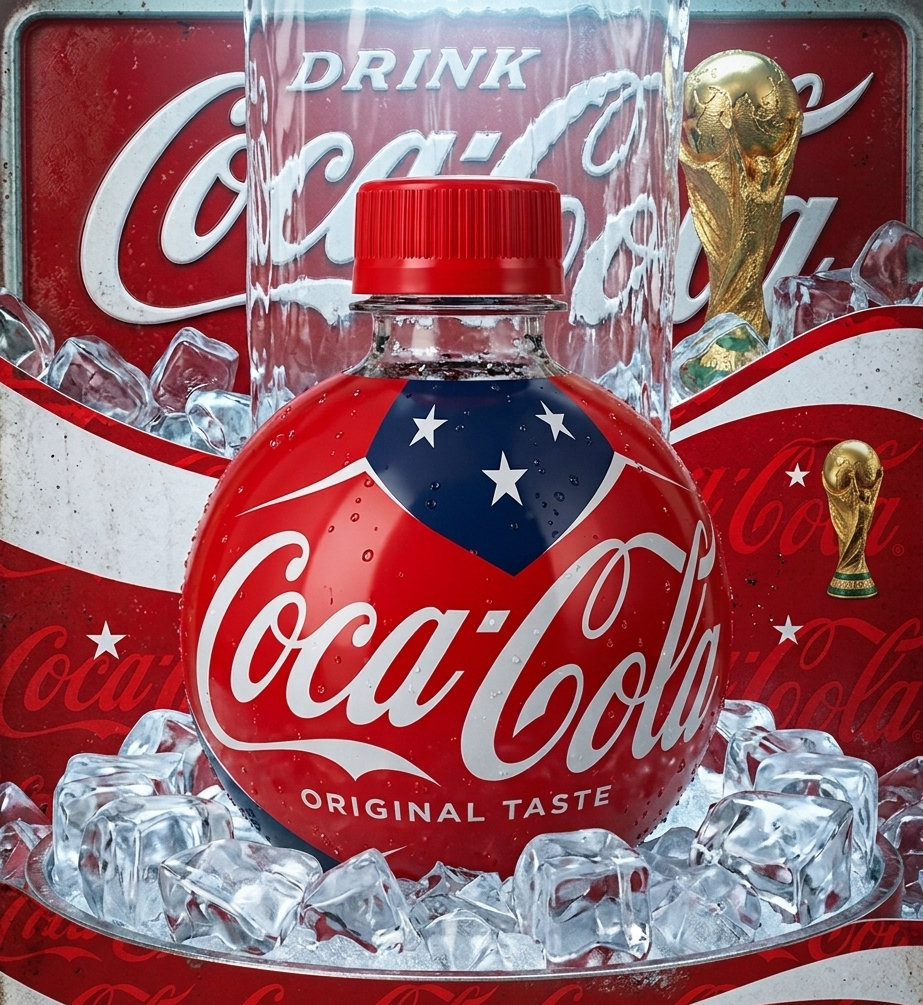


Coca-Cola’s limited-edition football-shaped bottles for FIFA World Cup 2026 represent something increasingly rare in global brand marketing, which is a creative decision that works simultaneously as functional packaging, collectible object, cultural artifact, and strategic World Cup activation.
The execution succeeded because it understands a fundamental principle. Meanwhile, the best brand moments happened when the product itself became the message rather than merely carrying it.
The shape matters more than superficial appeal, especially as a football-shaped bottle forces deliberate design thinking; how does liquid sit inside a sphere? How does someone hold it? What does the aesthetic communicate about the brand’s confidence in its own recognition?’
In that case, by transforming Coca-Cola’s iconic silhouette into recognisable football form, the brand made a choice that respects both its heritage and cultural moment. The shape is not a random novelty.
Interestingly, it is a functional metaphor, where the bottle becomes the ball, while the product becomes the sport. On the other hand, the consumer becomes a participant in football culture rather than an observer of brand messaging.
However, restraint matters equally, since Coca-Cola did not overcomplicate the design with excessive World Cup graphics or tournament branding competing for visual attention. The shape itself communicates. The bottle IS the World Cup activation, not a carrier of it.
Over time, most brand World Cup partnerships deploy conventional playbooks: sponsorship logos, athlete endorsements, limited-time campaigns disappearing when the tournament ends. Coca-Cola’s approach extends activation across multiple consumer touchpoints simultaneously.
Notably, fan campaigns encourage social sharing, as the distinctive shape makes bottles inherently photographable. In the same vein, trophy tours create in-person experiences transforming abstract sponsorship into tangible moments. As a result, collectible experiences build emotional investment beyond single purchase.
At the same time, partnership structures ensure sustained presence throughout the tournament lifecycle rather than front-loaded promotional spend.
Again, the strategy recognises that World Cup audiences span multiple engagement levels: casual viewers, passionate supporters, collectors, gift-givers. Obviously, a single football-shaped bottle accommodates all these motivations while the casual viewer buys because it’s novel.
Consequently, the supporter buys because it is their tournament made tangible while the collector buys because limited-edition creates scarcity. The gift-giver buys because it’s culturally resonant without requiring explanation.
In all of these, football sits at the intersection of global culture and intensely local passion. No doubt, a Brazilian supporter’s relationship to the World Cup differs fundamentally from a Japanese supporter’s, yet both claim equal emotional investment.
With this, Coca-Cola’s packaging strategy acknowledges this paradox: create universal objects (football) enabling individual cultural expression.
Moreover, the bottle becomes collectible precisely because it’s temporary and at the same time, scarcity drives value. So, nostalgia attaches to specific moments, “I remember the 2026 World Cup bottle.”
Subsequently, the brand understood that ephemeral products often generate stronger emotional connections than permanent ones because they force decisions: do I keep this or consume it?
Against this background, what separates this activation from standard sponsorship is commitment to craft over messaging. Although, the brand did not need to explain anything.
In turn, the shape explained itself, the same with the The cultural moment itself, as well as the collectability itself.
Importantly, this is the difference between brands showing up at culture and brands contributing to it: Coca-Cola created an object people wanted to own regardless of brand association. Furthermore, the Coca-Cola identity enhanced the object’s appeal but it did not carry the entire communication weight.
Eventually, for global brands navigating an increasingly crowded sponsorship landscape, the lesson is clear, and that is, shape culture through objects worth keeping, not through campaigns worth ignoring.
Beyond this, make the product the story and then, let consumers decide what story means to them.
ALSO WATCH:MARKETING EDGE ONTV




Comment
No comments found.