
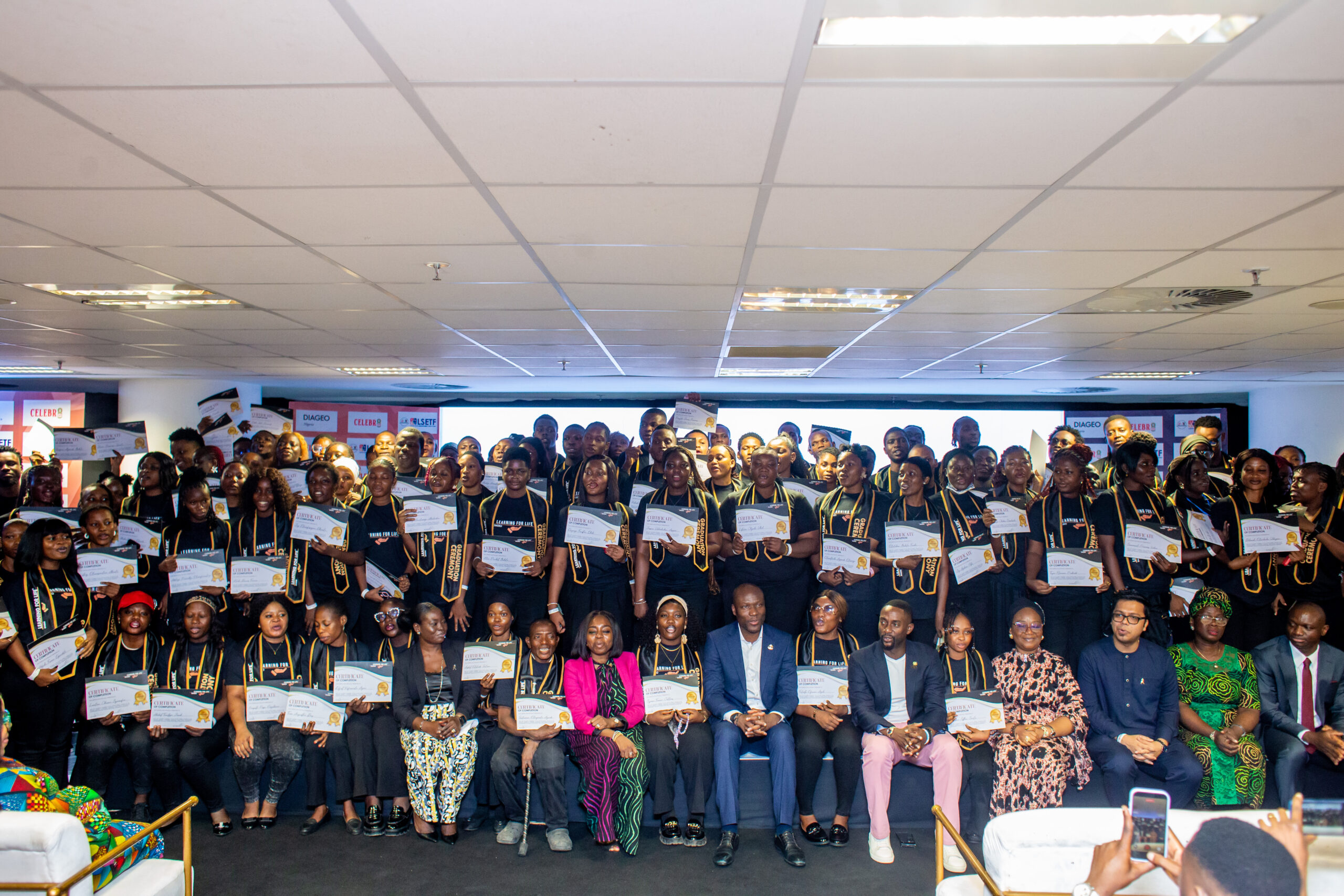




Diageo Nigeria has formally graduated 157 young Nigerians under its Learning for Life skills‑development programme, reaffirming its commitment to tackling youth unemployment and strengthening capabilities in the hospitality and tourism sector.
The event, held on Friday in Lagos, also marked the company’s pledge to expand the initiative nationwide, deepening its footprint in skills‑centred empowerment across the country.
The graduation ceremony brought together government officials, private‑sector partners and beneficiaries, underscoring the growing convergence of corporate, governmental and civil‑society efforts in youth development. At the heart of the day’s message was the idea that equipping young people with practical, job‑ready skills is not just philanthropy, but a strategic investment in Nigeria’s economic future.
Speaking at the event, Mr Adebayo Alli, general manager, Diageo Nigeria, stated that the Learning for Life programme in Nigeria was designed to empower 250 youths in 2025, with deliberate emphasis on women and persons living with disabilities. The maiden cohort attracted over 1,000 applications, reflecting high demand among young Nigerians for structured training and placement opportunities.
According to him, Diageo’s investment in youth empowerment aligns with the company’s broader mission of creating positive social impact in the communities where it operates. The programme sits within a global framework where Diageo has already impacted over 200,000 beneficiaries across 21 countries, including Ghana, Uganda, South Africa and Tanzania.
Chiamaka Anenechukwu, executive assistant to the general manager, Diageo Nigeria and current Learning for Life Project Manager, explained that Learning for Life is not a new initiative. “It’s not a new programme; it has been in existence,” she said, recalling that the framework began in 2008 in Latin America with a simple but powerful objective: to break down barriers to employment for young people.

Globally, she noted, more than 59% of Learning for Life beneficiaries are women. In Nigeria, the gender balance tilts even higher, with 68% of the current cohort being female graduates. This underscores Diageo’s deliberate focus on inclusion and equitable access to opportunities.
In the Nigerian context, Anenechukwu disclosed that over 1,100 applicants vied for participation, out of which 740 were shortlisted. From that pool, 303 participants completed an intensive classroom training programme covering hospitality, health and hygiene, personal branding, financial literacy and conflict management. Of these, 157 advanced to an 11‑week internship placement across hotels, restaurants, bars and lounges in Lagos State an experience that bridged classroom learning with real‑world industry exposure.
Oluwakemi Yetunde Kalesanwo, director Lagos State Agency for Mass Education, representing Tolani Sule, commissioner Ministry of Tertiary Education, described the Learning for Life graduation as a celebration of empowerment, achievement and opportunity.
She praised the programme for its focus on practical hospitality, entrepreneurship and employability skills, arguing that such interventions are critical at a time when skills development and youth empowerment are central to Nigeria’s economic growth and social stability.
Echoing that sentiment, the Lagos State Commissioner for Youth and Social Development, Mr Mobolaji Ogunlende, commended Diageo Nigeria for creating pathways that go beyond “white‑collar” employment. He noted that youth account for about 60 per cent of Lagos State’s population, making targeted interventions through vocational and hospitality training all the more urgent.
“Too often, I see bright and intelligent young people simply searching for opportunities,” Ogunlende said. “The truth is that not every young person will secure a white‑collar job, but everyone deserves a platform to develop their talents and build a future.” He described the programme as more than corporate social responsibility, stressing that it restores confidence and inspires hope among young people facing economic challenges.
Lagos State Ministry of Tourism, Arts and Culture, speaking on behalf of the Honourable Commissioner, also highlighted the transformative impact of the initiative. The ministry praised Learning for Life for equipping participants with skills in hospitality, entrepreneurship and employability while cultivating healthy workplace culture in a rapidly changing world.
Idera Yetunde Folakemi, deputy director, ministry of Art, representing, Toke Benson-Awoyinka, Commissioner for Tourism, Arts and Culture, Lagos State, emphasised sectors are not only significant drivers of job creation but also platforms for young people to express creativity, showcase talent and build sustainable livelihoods. “We must continue to invest in our youth, in private sector partnerships and in an enabling environment, because when learning translates into productivity and talent into impact, society as a whole benefits,” the representative noted.
“Success is not only about personal achievement; it is about contribution – using your skills to uplift others, strengthen your community and add value to society.”

One of the most moving moments of the ceremony came from Faustina Onyinye, one of the graduates, who shared how the programme transformed her life after years of hardship. An orphan who lost both parents, Faustina admitted that life had been unkind for a long time. She initially approached the programme with scepticism but eventually decided to apply, calling it a “leap of faith.”
The training and internship components, she said, gave her not just skills but renewed confidence and a clearer sense of direction. Her testimony underscored the broader narrative of the day: that structured, well‑supported skills development can change trajectories for even the most vulnerable young people.




Comment
No comments found.