
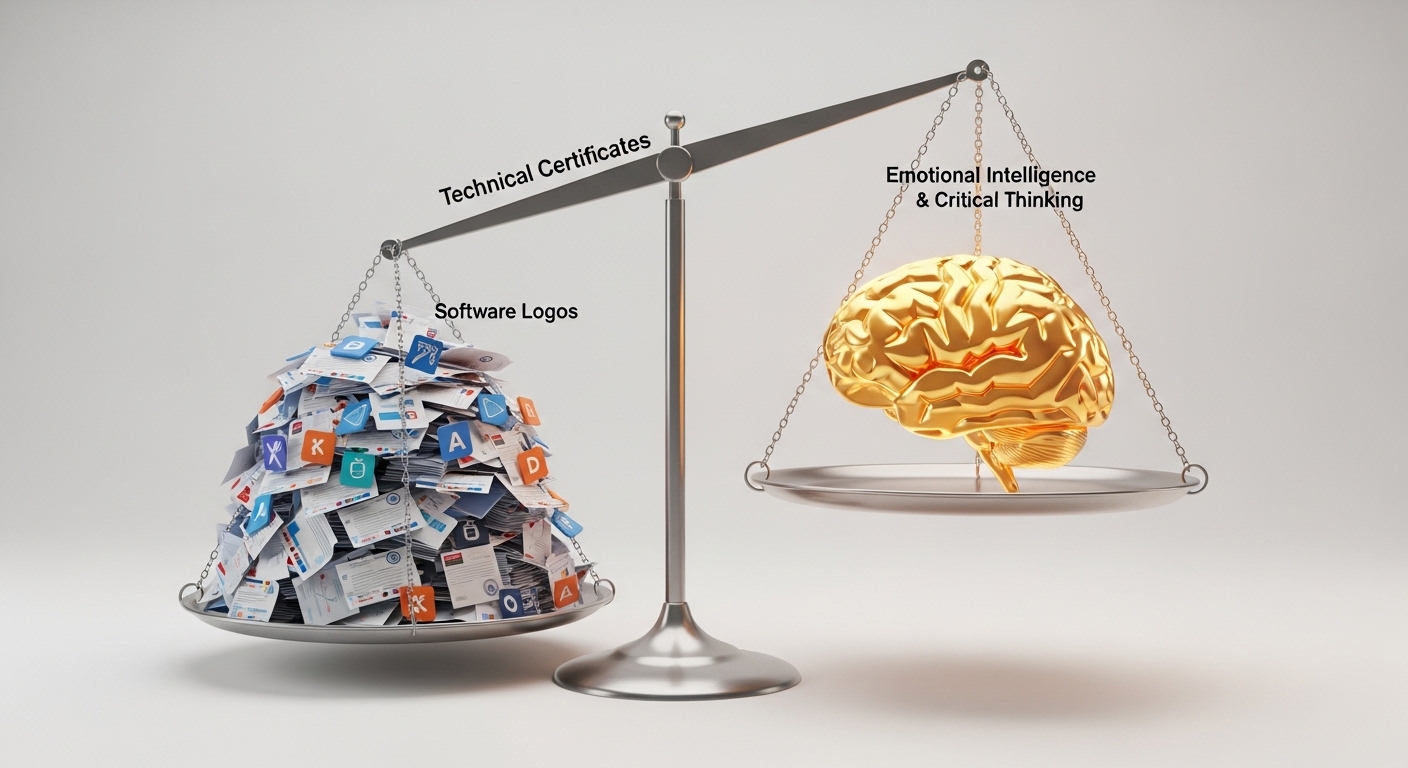


Nigerian marketing teams invested millions in martech stacks, analytics platforms, automation tools, and AI assistants that generate campaign assets in minutes. The technology handles execution brilliantly. What it cannot handle is the moment when a client’s face tightens during a presentation, and the marketer misses the signal that the entire pitch just failed.
It cannot read the silence during a strategy session, which means the team disagrees but will not speak up. It cannot detect when a consumer research participant gives the socially acceptable answer, whilst their body language screams the opposite truth.
These moments, where campaigns succeed or collapse, require soft skills that 92 per cent of hiring managers now value equally or more than technical expertise, according to 2025 research. Yet marketing education and professional development still prioritise platform certifications over emotional intelligence training that determines whether those skills ever get applied effectively.
The automation paradox explains why soft skills became more valuable precisely when hard skills became easier.
When AI generates campaign copy in seconds, writing ability becomes a commodity. When templates automate design, Photoshop mastery becomes a baseline expectation rather than a differentiator.
The scarcity shifts to capabilities AI cannot replicate: reading a client’s unstated concerns, navigating political dynamics within accounts, adapting strategy mid-presentation when audience body language reveals the pitch is not landing, and building trust that makes clients choose your agency over a competitor with identical capabilities but weaker relationships.
The hiring data quantifies what practitioners already observe. Ninety-seven per cent of employers agree that soft skills impact job performance. Yet only 31 per cent believe candidates possess sufficient soft skills, a gap that persists because educational systems teach campaign strategy whilst assuming interpersonal competence develops accidentally.
Marketing degrees cover segmentation, positioning, and media mix optimisation. They rarely teach how to deliver feedback that improves a junior’s work without destroying confidence, how to disagree with a superior’s strategy without appearing insubordinate, or how to present research findings a client paid for but does not want to hear.
Emotional intelligence sits at the centre of this soft skills constellation.
The concept encompasses self-awareness, self-regulation, motivation, empathy, and social skills, capacities that enable marketers to understand how others feel and work effectively with them.
In the Nigerian context, where hierarchical business culture values relationships and respect alongside results, emotional intelligence determines whether a brilliant strategy ever gets implemented or dies during stakeholder alignment because the marketer could not navigate organisational dynamics.
The client management application is direct.
A client says the brief is clear. A marketer with low emotional intelligence accepts the statement literally and proceeds to execution. A marketer with high emotional intelligence hears hesitation in the voice, notices contradictions between stated objectives and budget allocation, and asks probing questions that surface the actual concerns the client has not articulated, even to themselves.
The difference between these scenarios is not strategic thinking or creative capability. It is emotional attunement that recognises the gap between what people say and what they mean.
Research demonstrates that teams with strong communication experience a 20 to 25 per cent productivity boost, according to Deloitte analysis.
The mechanism is straightforward: when team members communicate clearly, listen actively, and set expectations explicitly, less time is wasted on misalignment, repeated work, and conflict resolution.
Marketing agencies operating on tight margins cannot afford a 20 per cent productivity penalty caused by poor communication. Yet communication skills receive a fraction of the training investment compared to technical platform training, because proficiency is easier to assess than interpersonal effectiveness.
The adaptability requirement has intensified as marketing channels proliferate and consumer behaviour shifts continuously.
Technical skills become obsolete within years, sometimes months, as platforms update algorithms, new channels emerge, and measurement frameworks change.
Soft skills like adaptability, curiosity, and comfort with ambiguity enable marketers to learn new technical skills efficiently rather than becoming obsolete when their specialisation loses relevance.
The marketer who panics when the TikTok algorithm changes cannot survive in an environment where change is a permanent condition rather than a temporary disruption.
For Nigerian marketing professionals, collaboration across hybrid and remote teams adds further complexity to the soft skills requirement.
When face-to-face interaction decreases, trust must be built deliberately through consistent communication, reliable follow-through, and emotional intelligence that compensates for missing nonverbal cues.
Remote collaboration exposes weaknesses in soft skills that physical presence previously masked. The colleague who interrupts others in the conference room becomes the person who dominates video calls. The team member who reads the room poorly in person becomes completely lost in Zoom silence.
Critical thinking represents another soft skill that distinguishes marketers who execute instructions from those who improve strategies.
When a campaign underperforms, a critical thinker asks whether the strategy was wrong, the execution was flawed, or external factors changed the assumptions underlying the plan.
They consider multiple explanations, weigh evidence objectively, and adjust recommendations based on analysis rather than defending the original position because ego prevents admitting error.
This intellectual humility, a soft skill masquerading as analytical capability, matters more than technical sophistication when rapid iteration determines whether a brand captures a market opportunity before it closes.
The career progression reality is that hard skills determine hiring, whilst soft skills determine promotion and retention.
A junior marketer gets hired for Photoshop proficiency, Google Analytics certification, and social media management experience.
The same marketer gets promoted to management because they communicate clearly, give constructive feedback, resolve conflicts diplomatically, and inspire confidence in clients and colleagues.
The technical skills that secured the entry-level position become minimum qualifications rather than competitive advantages as a career advances.
For marketing leaders building teams, the soft skills gap represents both a challenge and an opportunity.
It is a challenge because recruiting processes optimised for assessing technical skills through portfolios and certifications struggle to evaluate emotional intelligence, adaptability, and communication effectiveness.
It is an opportunity because competitors struggle with the same problem, meaning organisations that solve soft skills identification and development create a talent advantage that compounds over time as high-EQ teams outperform technically proficient but interpersonally weak competitors.
The investment implication is uncomfortable: soft skills training delivers a higher ROI than additional martech subscriptions for most marketing teams.
Yet budgets flow towards platforms and tools because software purchases are easier to justify than development programmes that improve emotional intelligence, communication, and adaptability.
The misallocation persists because hard skill gaps are visible, a team cannot use a tool they do not have, whilst soft skill gaps manifest as mysterious underperformance, client attrition attributed to other factors, and cultural problems leadership cannot diagnose because they lack the vocabulary for discussing interpersonal effectiveness systematically.
The future belongs to marketers who master both technical execution and human connection, but automation creates a divergence where technical competence alone becomes insufficient for career progression.
AI handles execution. Humans handle everything requiring emotional intelligence, cultural understanding, relationship building, and strategic judgment informed by reading signals that data does not capture.
Nigerian marketers investing exclusively in platform certifications whilst neglecting soft skill development are optimising for capabilities AI will commoditise, whilst ignoring the competencies that will determine which humans remain valuable after automation eliminates routine execution work.
The uncomfortable truth is that a marketing degree plus Photoshop plus analytics plus automation can still equal unemployment if you cannot read the room when the client goes quiet, and you need to pivot immediately before losing the account you spent six months winning.
ALSO WATCH:MARKETING EDGE ONTV



Comment
No comments found.