
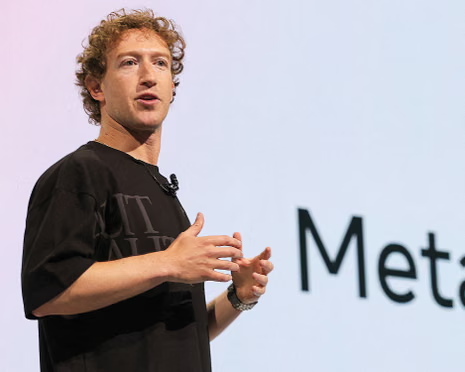




Meta is building a photorealistic AI-powered version of CEO Mark Zuckerberg trained on his mannerisms, tone, publicly available statements, and strategic thinking to enable employee interactions when the founder himself is unavailable, Financial Times reported on 14 April 2026 citing four people familiar with the project.
The digital character, developed by Meta’s Superintelligence Labs, aims to help employees “feel more connected to the founder through interactions with it” according to a source briefed on the initiative. Zuckerberg is personally involved in testing AI versions, spending five to ten hours weekly working on various AI projects including training digital replicas of himself.
The brand implications reveal uncomfortable truths about leadership at scale. When a company employs 79,000 people and the founder is “by any measure, difficult to reach,” leadership accessibility becomes a mathematical impossibility rather than a cultural failure. Creating an AI proxy solves capacity problems whilst introducing an authenticity crisis.
Employees interact with algorithms trained on historical statements and strategic thinking rather than humans responding to the current context with genuine judgment. The delegation signals that connection to the founder matters enough to simulate but not enough to prioritise through actual availability.
The distinction between the AI version that interacts with employees versus the CEO agent that handles tasks for Zuckerberg matters strategically. The CEO agent represents productivity enhancement, automating information retrieval, scheduling, and administrative work that consumes executive time without requiring executive judgment. The AI version represents presence delegation, substituting algorithmic responses for human engagement when employees seek guidance, feedback, or connection to leadership. The former improves efficiency. The latter replaces the relationship with simulation.
The precedent exists beyond Meta. Uber CEO Dara Khosrowshahi mentioned during a podcast interview earlier in 2026 that employees had built an AI clone of him. But scale and institutional purpose differ substantially.
Khosrowshahi’s clone emerged from employee initiative experimenting with available technology. Zuckerberg’s clone represents a formal corporate strategy designed as “a mechanism for the $1.6 trillion company’s 79,000 employees to feel a sense of connection” to an otherwise inaccessible founder. The formalisation transforms curiosity projects into leadership substitutes.
The training methodology raises questions about what employees receive when interacting with AI Zuckerberg. An algorithm trained on mannerisms and tone replicates speech patterns and communication style. Training on publicly available statements ensures consistency with external messaging. But publicly available statements represent carefully crafted positions designed for stakeholder consumption rather than internal guidance addressing specific operational challenges employees face. The AI version can replicate how Zuckerberg communicates whilst fundamentally lacking the capacity to exercise judgment about situations it hasn’t encountered.
The business context driving AI delegation reveals Meta’s competitive positioning. Zuckerberg has pledged significant investment in what he describes as “personal superintelligence” whilst the company faces intensifying competition with OpenAI and Google developing advanced AI systems. Internal pressure to “accelerate pace of work, eliminate layers from organisational structure and change day-to-day jobs of employees to remain competitive with AI-native startups with much smaller staffs” according to the Wall Street Journal creates an environment where AI substitution for human interaction becomes an operational necessity rather than experimental innovation.
Meta’s previous experiments with digital representations of Zuckerberg provide context for the current initiative. In 2022, Zuckerberg unveiled a virtual avatar of himself within the metaverse platform that drew criticism for its visual quality. The company subsequently abandoned its metaverse focus while shifting heavily toward AI development. The evolution from a criticised metaverse avatar to a photorealistic AI clone demonstrates technological improvement whilst maintaining a consistent objective: scaling the founder’s presence beyond physical constraints that limit direct interaction.
The employee perspective remains notably absent from reporting about the AI Zuckerberg development. Whether employees desire interaction with the AI version of the founder versus preferring a clearer organisational hierarchy that doesn’t require simulated access to inaccessible executives is unknown. The assumption that employees “might feel more connected” through AI interaction presumes that connection derives from interacting with an approximation of the founder rather than from a substantive relationship with the actual leadership that makes itself available.
For Nigerian business leaders evaluating implications, the Meta case study demonstrates that company scale eventually forces a choice between authentic leadership accessibility and simulated connection. At 79,000 employees, the individual relationship between the founder and the workforce becomes impossible. The traditional solution involves building management layers where employees connect with immediate supervisors who connect upward through the hierarchy. AI solution attempts to maintain the illusion of a flat organisation where everyone can “talk to the boss” by replacing the boss with an algorithm trained to respond like him.
The brand question is whether a simulated connection to an inaccessible founder delivers more value than a transparent hierarchy where employees know they interact with managers accountable to leadership rather than an algorithm programmed to approximate it. Meta’s $1.6 trillion valuation suggests the operational model works regardless of how the founder delegates presence. Whether it works because of an AI-mediated connection or despite it remains an open question that the deployment of AI Zuckerberg will test empirically across 79,000 employees who must decide if talking to an algorithm trained on the boss’s mannerisms constitutes meaningful leadership accessibility or elaborate corporate theatre substituting simulation for substance.
ALSO WATCH:MARKETING EDGE ONTV




Comment
No comments found.