
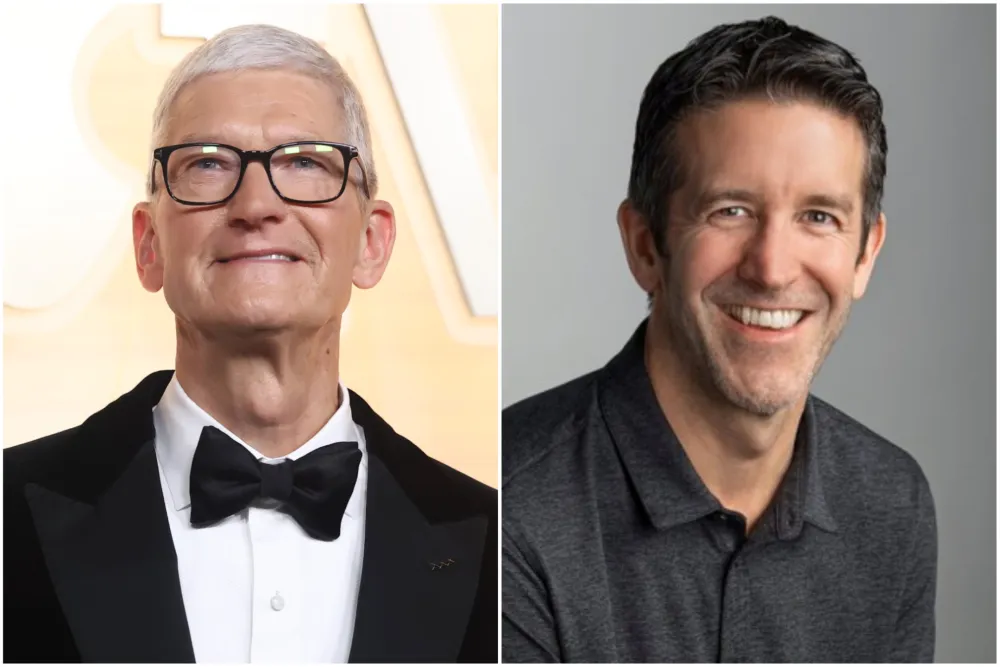


Apple announced on 20 April 2026 that John Ternus, Senior Vice President of Hardware Engineering, will succeed Tim Cook as Chief Executive Officer effective 1 September 2026.
Cook, who has led Apple since 2011, will transition to Executive Chairman whilst remaining CEO through the summer to ensure a smooth handover. The succession follows what Apple described as a “thoughtful, long-term succession planning process” approved unanimously by the board of directors. For marketers studying brand transitions, the appointment signals a strategic bet that hardware differentiation will matter more than the AI race that Apple currently trails in.
The numbers contextualise what Ternus inherits. Cook grew Apple’s market capitalisation from approximately $350 billion in 2011 to $4 trillion by April 2026, representing a more than twentyfold increase during his fifteen-year tenure. Annual revenue quadrupled to over $400 billion. The growth came not from revolutionary product categories, but from operational excellence, supply chain mastery, and incremental innovation across an expanding product ecosystem, including Apple Watch, AirPods, and the Vision Pro headset.
Ternus brings a fundamentally different background from the one Cook brought when succeeding Steve Jobs. Cook was an operations specialist hired by Jobs in 1998 specifically to fix Apple’s disastrous supply chain. His expertise was not product vision. It was manufacturing efficiency, supplier consolidation, and inventory management. The operational discipline he imposed enabled Apple to scale production whilst maintaining margins competitors could not match.
Ternus represents the opposite profile. A mechanical engineer who joined Apple’s product design team in 2001, he spent twenty-five years overseeing hardware engineering for virtually every major product in the current portfolio. His fingerprints are on every iPad generation, the latest iPhone lineup, AirPods development, the Mac’s transition to Apple silicon, and the Vision Pro mixed reality headset. Where Cook excelled at making products efficiently, Ternus excelled at making products exist.
The strategic signal matters because Apple faces different challenges now than it did in 2011. When Cook inherited the company, the question was whether Apple could survive without Jobs’s product vision. Cook answered by proving that operational excellence and ecosystem lock-in could sustain growth without revolutionary hardware. The current question is whether hardware excellence can sustain growth when software intelligence determines product value. Apple lags competitors in artificial intelligence capabilities that increasingly define user experience.
Industry analysts noted the pressure immediately. Dan Ives stated: “There will be a lot of pressure on Ternus to produce success out of the gates, especially on the AI front.” Forrester analyst Dipanjan Chatterjee observed: “Ternus is a hardware engineer, which signals that Apple will seek differentiation in its physical products even as it looks to reframe the device as a substrate for intelligent experiences.”
The tension is genuine. Competitors, including Google, Microsoft, and Meta, have embedded advanced AI capabilities directly into operating systems and core applications. Apple delayed its Siri upgrade, revamped AI leadership in December by replacing its chief with a Google veteran, and announced an updated Siri launching this year based on Google Gemini AI models rather than proprietary technology. These moves suggest Apple recognises an AI deficit but has not resolved it through internal development.
Ternus’s appointment represents a calculated gamble that superior hardware can offset software disadvantage. His background includes an early career at Virtual Research Systems designing VR headsets, experience directly applicable to Vision Pro development. His work on the Mac helped the category become “more powerful and more popular globally than at any time in its forty-year history”, according to Apple’s announcement. He also drove innovations in materials, including recycled aluminium compounds, 3D-printed titanium, and repairability improvements that extended product lifespans.
The hardware-first strategy assumes consumers prioritise device experience over software intelligence, or that hardware quality enables software differentiation through integration rather than raw AI capability. It is defensive positioning disguised as strength. Strong hardware matters less when AI assistants handle tasks regardless of device quality. Beautiful hardware design becomes a commodity when competitors match materials and manufacturing whilst exceeding intelligence.
For Nigerian marketers evaluating brand implications, the succession reveals how companies communicate strategic priorities through leadership selection. Cook’s appointment in 2011 signalled that Apple valued operational stability over product revolution. Ternus’s appointment signals a belief that product innovation through hardware engineering will differentiate better than the AI arms race, where Apple trails established leaders.
The contrast with competitors is stark. Microsoft CEO Satya Nadella came from a cloud computing background when cloud represented Microsoft’s future. Google CEO Sundar Pichai came from Chrome and Android when the mobile-first internet defined Google’s challenge. Both appointments aligned leadership expertise with strategic imperative. Ternus’s appointment aligns leadership expertise with Apple’s historical strength rather than its current weakness.
Cook’s farewell statement emphasised continuity: “John Ternus has the mind of an engineer, the soul of an innovator, and the heart to lead with integrity and honour.” Ternus reciprocated: “Having spent almost my entire career at Apple, I have been lucky to have worked under Steve Jobs and to have had Tim Cook as my mentor.” The mutual endorsement frames the transition as seamless continuity rather than a strategic pivot, which itself reveals the brand’s preference for stability over disruption.
The brand challenge Ternus faces exceeds what Cook inherited. Jobs died six weeks after handing Cook the CEO role. That tragedy created a grace period where any competent stewardship would be praised. Cook does not have a terminal illness. He is sixty-five years old, transitioning to Executive Chairman, and remaining engaged with policy work globally. His presence as chairman means Ternus operates under the shadow of a predecessor whose legacy he must either extend or surpass.
Apple’s brand promise under Cook was operational excellence, delivering premium products that “just work” within a tightly integrated ecosystem. The promise succeeded because it did not require breakthrough innovation, only reliable execution of a proven formula. Ternus must deliver that same reliability whilst solving the AI deficit that operational excellence cannot address. Hardware engineering skills will not code better language models. Apple will need to attract AI talent that currently prefers competitors offering cutting-edge research problems rather than catch-up assignments.
The succession planning demonstrates best practice in brand continuity management: a lengthy transition period, internal promotion that preserves cultural knowledge, and an outgoing CEO remaining as chairman to provide institutional memory. But perfect execution of the succession process does not guarantee strategic success when a new CEO’s expertise does not match the company’s most urgent strategic challenge.
Apple is betting that hardware differentiation will matter more than AI capability. The market will determine whether that bet proves to be brand wisdom or brand delusion.
ALSO WATCH:MARKETING EDGE ONTV


Comment
No comments found.