
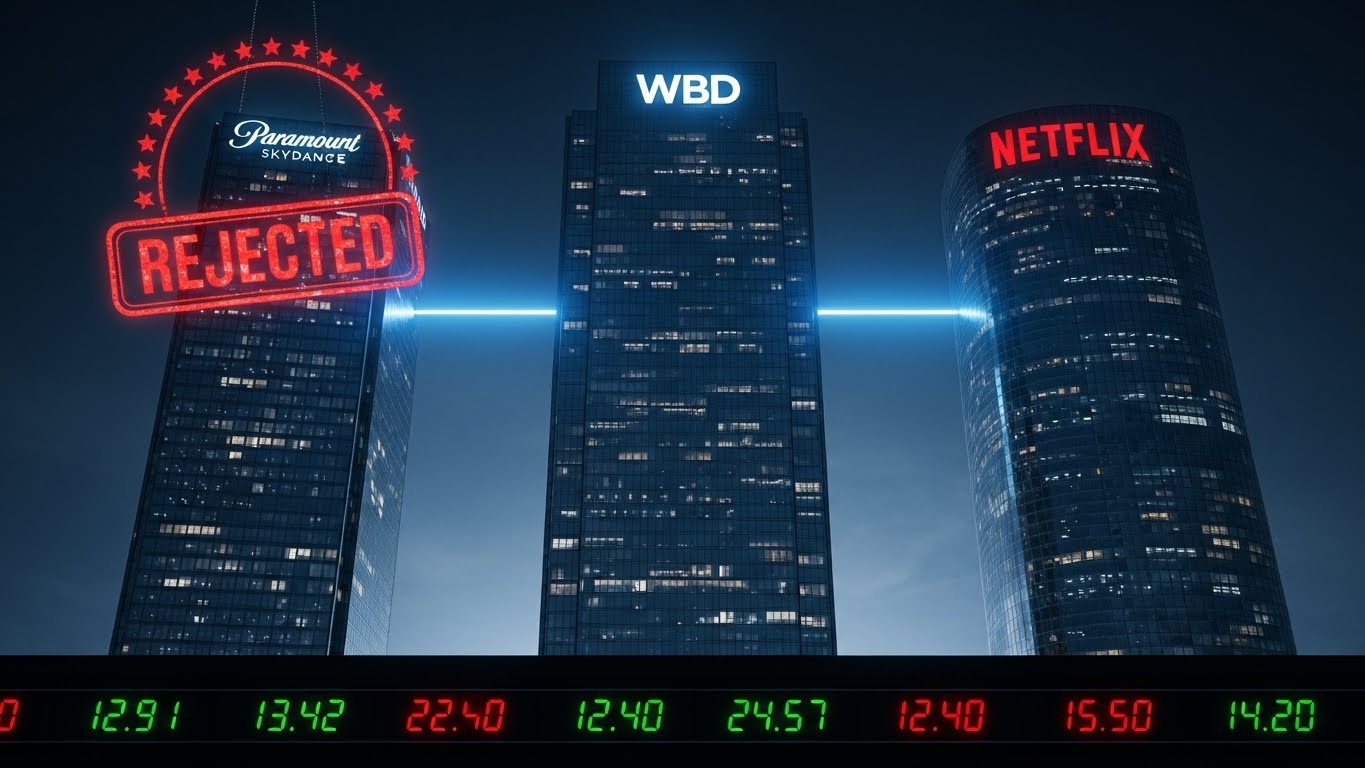


The rules of consolidation have changed sharply, and Warner Bros. Discovery’s rejection of Paramount Skydance’s $108.4 billion hostile takeover bid is a defining moment in a highly publicized corporate battle in Hollywood.
It appeared like Paramount’s offer was quite attractive on paper. It should have been hard to turn down an all-cash deal of $30 per share that valued the entire Warner Bros. Discovery group higher than competing offers. The board, however, might have sensed far too much uncertainty and danger lurking beyond the surface of the headline figure.
Warner Bros Discovery has opted for a more focused and financially secure agreement with Netflix, prioritizing stability over expansion during a period of heightened scrutiny from investors, regulators, and labour groups.
The Financing Question That Wouldn’t Go Away
The core reason for Warner Bros Discovery’s rejection stemmed from skepticism regarding Paramount’s capacity to completely fund the transaction.
Paramount Skydance has indicated that its offer is supported by the Ellison family; however, it appears that only a fraction of the proposed equity, approximately one-third, was secured within a trust structure that permits withdrawal under specific conditions. The board of Warner Bros Discovery found the level of uncertainty to be unacceptable, especially considering the deal’s size and complexity.
In the current market environment, characterized by elevated debt costs and fluctuating equity markets, boards are becoming progressively cautious of proposals that depend predominantly on future financing assumptions rather than firm commitments. Paramount’s offer, notwithstanding its prominent valuation, entered that critical risk threshold.
In contrast, Netflix’s offer of $27.75 per share for Warner Bros’ studio and streaming assets included more defined funding arrangements and fewer complexities, which is a significant factor as shareholders prioritize predictability over ambition.
A Strategic Mismatch
In addition to financial considerations, Warner Bros Discovery seemed to lack confidence in the strategic reasoning put forth by Paramount.
Paramount’s proposal aimed to take control of the entire company, encompassing its traditional cable networks, a segment that is experiencing a long-term decline as audiences shift away from linear television. Although consolidation may offer immediate efficiencies, merging two legacy-laden media groups would probably exacerbate, rather than alleviate, underlying structural issues.
On the other hand, Netflix is being purposefully selective with their bid. The streaming giant is aiming for assets that fits digital-first strategy by concentrating on Warner Bros’ studios, IP, and HBO Max. It place to spin off Warner Bros; worldwide networks independently.
The distinction held significant importance for Warner Bros Discovery. The board’s preference indicates a conviction that the future is rooted in concentration rather than expansion.
What This Says About the Industry Right Now
The rejection of Paramount’s proposal highlights a significant change in the landscape of media transactions.
Until recently, achieving scale at nearly any expense was the prevailing rationale. Currently, scaling without financial clarity poses a significant risk. Investors exhibit skepticism, regulators maintain vigilance, and boards face pressure to circumvent transactions that may collapse under examination.
The decision made by Warner Bros Discovery is indicative of this reality. By prioritizing Netflix’s conservative structure, the company indicates that the risks associated with execution now surpass the potential theoretical gains, even when those gains amount to tens of billions of dollars.
A Setback for Paramount, A Signal to Rivals
Although this rejection is a major setback, Paramount Skydance does not see it as the final chapter. The business has maintained that it could better compete with Disney and Netflix if it combined Warner Bros and Paramount’s film, television, and sports libraries.
Warner Bros Discovery’s response indicates that having a vision is insufficient on its own. In an industry facing diminishing margins and increasing expenses, boards are seeking evidence, not assurances.
What Comes Next
The focus now shifts to the regulatory examination of Netflix’s proposed acquisition and the acceptance of additional consolidation in the already crowded streaming business, as Paramount’s hostile bid was rejected.
For Warner Bros Discovery, this decision signifies the conclusion of one phase while initiating another characterized not by growth but by a focus on discipline. The company has prioritized stability over extravagance, indicating that even in Hollywood, the largest transactions must now endure the rigorous scrutiny of financial analysis.
By rejecting Paramount, Warner Bros Discovery has underscored a critical point: the trajectory of media consolidation will hinge not on the highest bid, but on the ability to persuade boards and regulators that the proposed deal in viable and sustainable.
ALSO WATCH MARKETING EDGE ONTV


Comment
No comments found.