
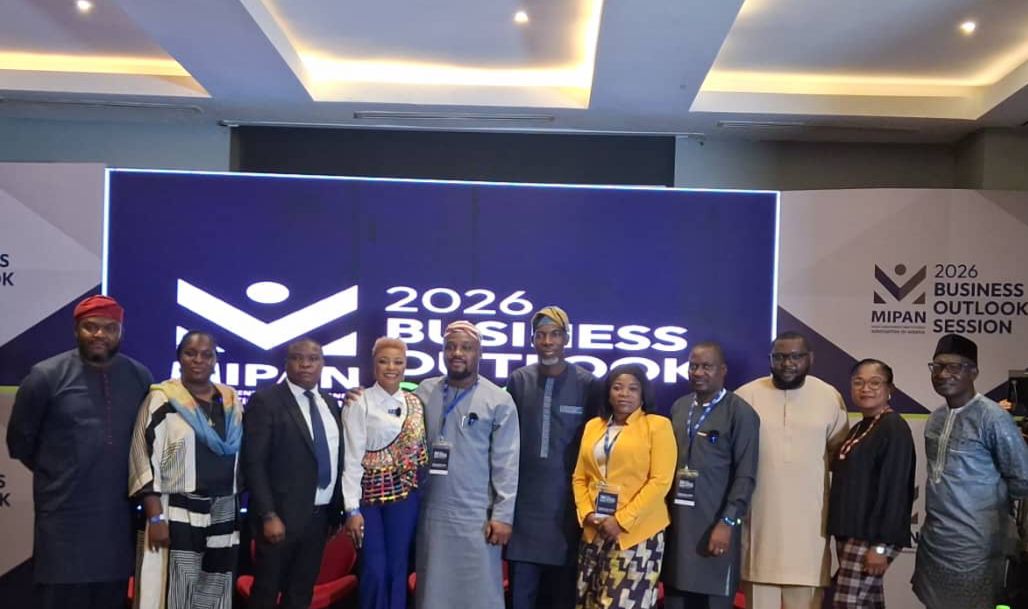


The Media Independent Practitioner Association of Nigeria (MIPAN) convened industry stakeholders. They met to examine Nigeria’s evolving business environment. The 2026 Business Outlook Session addressed the implications for the integrated marketing communications sector. It was held at the Radisson Blu Hotel, Ikeja, Lagos.
The event brought together MIPAN members, industry experts, and thought leaders. They discussed how tax reforms, digital transformation, and emerging market trends are reshaping the advertising and marketing landscape.
Navigating Economic Challenges with Innovation
MIPAN President Doze Okafor, represented by Vice President Brenda Nwagu, acknowledged the pressures facing businesses. “Over the past year, we navigated fluctuating exchange rates, inflationary pressures, and rising operational costs,” she said. She added that shifting consumer behavior, shaped by economic realities, further challenged the industry. “These factors have reshaped how businesses operate. They have also changed how brands connect with audiences,” she explained.
Despite these challenges, she noted that significant opportunities exist. “The acceleration of digital adoption creates fresh pathways for innovation,” she stated. This includes the growth of SMEs, the rise of new consumer markets, and increased investment in technology-led solutions. These pathways exist in advertising, content, media, and overall brand communication.
Tax Reforms and Industry Implications
The session focused heavily on Nigeria’s new tax reforms. These reforms broaden the tax base, strengthen compliance, enhance government revenue, and create a more transparent fiscal framework. Key components include revised VAT thresholds and stricter withholding tax enforcement. The rules also introduce digital economy tax provisions affecting content creators and advertisers. Furthermore, businesses operating across multiple states now face new reporting requirements.
The MIPAN president outlined the direct impact on the marketing communications industry. “These changes will impact every sector of the economy, including marketing communications,” she stated. The implications are clear: media agencies, creative agencies, and digital service providers face higher compliance obligations. Digital transactions, including influencer marketing, digital media buying, and cross-border advertising services, will face greater scrutiny.
However, she also identified opportunities. “Agencies have an opportunity to lead with advisory capabilities,” she said. This helps clients navigate compliance, cost forecasting, and strategic planning. She also noted potential growth in local content and Nigerian-owned platforms as tax regulations tighten around foreign digital service providers.
Understanding Personal Tax Relief
Mr. Michael Olarinde, Head of Fiscal and Tax Reforms Implementation at the Federal Inland Revenue Service (FIRS), provided detailed insights. He covered tax reliefs available to individuals and businesses.
He explained that individuals with taxable income below $\text{N}800,000$ are charged at 0%. “You will have taken out what they call reliefs before you get to a taxable income of $\text{N}800,000$,” Olarinde said. These reliefs include National Housing Fund contributions, pension contributions, life insurance for you and your spouse, and National Health Insurance Scheme contributions. “So, people who earn about $\text{N}1.2$ million will not pay tax,” he concluded.
On rent relief, he clarified the government’s stance: “Government is saying, ‘I want to relieve part of your rent by $\text{N}500,000$ or 20%, whichever is lower.'” He stressed, “You must provide your rental receipts or agreements to claim that money.” When the tax authority receives that receipt, it will follow up to collect tax from the landlord.
Olarinde also addressed cryptocurrency taxation. “You are allowed to take away the losses from your gain before you pay your tax when you are trading crypto assets or digital assets,” he explained. “That is equity.”
On tax exemptions for religious and charitable organizations, he was clear about boundaries. “Income or profit of educational institutions, religious, and charitable activities are tax-exempt. However, it should not be from trade or business,” he stated. “If you are in a church and your permanent site has a marquee or a hall that you are using for rental for parties, you are competing with people who do hall rentals for business, and you must pay tax on the rental income.”
The Digital Imperative
Dr. Vincent Nwani, Strategy Lead for West Africa at Safrican Investment Group, emphasized digital transformation’s importance. He noted that over 50% of sectors in Nigeria are investing heavily in social platforms. He described the shift as a “guerrilla attack” from various directions, including AI and social media.
“Marketers are under pressure to demonstrate return on investment and meet key performance indicators,” Dr. Nwani said. He highlighted the shift from traditional measurement methods to modern performance metrics. These modern metrics directly link advertising spend to business outcomes.
Looking Ahead
The consensus from the session was clear. Nigeria’s business environment presents significant challenges. However, it also offers unprecedented opportunities for agencies and practitioners. Success depends on their willingness to adapt, innovate, and build institutional capacity. The key for 2026 and beyond lies in understanding regulatory changes, embracing digital transformation, and positioning to meet evolving client demands.
Also Watch: MARKETING EDGE ONTV



Comment
No comments found.