




For decades, Apple has shown its audience a perfect iPhone. Gleaning. Pristine. Photographed under studio lighting so controlled it made the device look less like a phone and more like a piece of jewellery. Every product shot was flawless. Every advertisement suggested that the iPhone existed in a world where fingers left no marks, toddlers did not exist, and dogs had never encountered a screen.
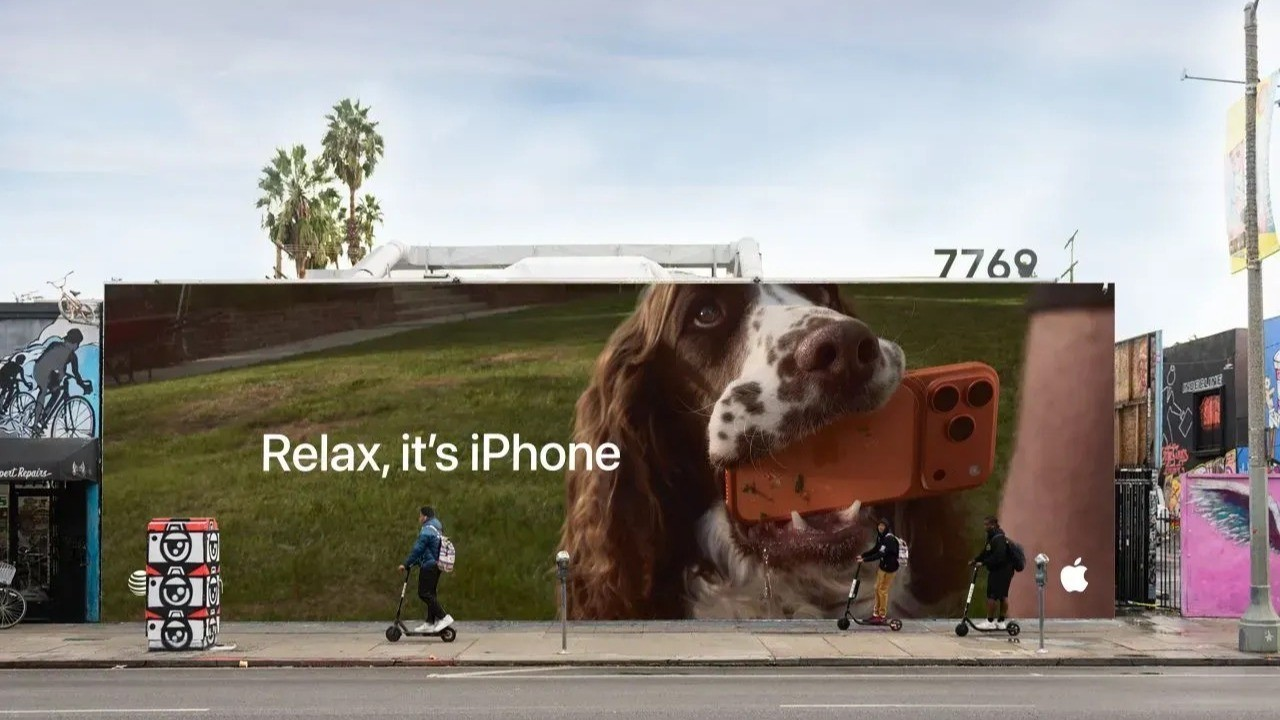
Then Apple put a spaniel biting an iPhone on a billboard in New York. And somehow, it worked better than everything that came before it.
The campaign is called “Relax, it’s iPhone.” Created by Apple’s internal creative team and now running across out-of-home placements in New York, Los Angeles, and San Francisco, it represents something genuinely unprecedented in Apple’s advertising history: the first time the platform has moved into outdoor advertising. Furthermore, it does so by showing iPhones in conditions that Apple’s previous advertising went to extraordinary lengths to avoid.
The campaign features a variety of executions: a spaniel gripping an iPhone between its teeth, a phone balanced precariously on a bathtub faucet while its owner soaks nearby, and a toddler smearing fruit purée across a camera lens. None of the wear is played as damage. Moreover, each slot is staged to prove the phone can survive it. The campaign also highlights the Find My Phone feature, because sometimes the phone ends up somewhere the owner did not intend.
Apple creative Ben Martin, who created the series with Kendal Bagwell, explained the shift on LinkedIn: “It’s the first time we’ve taken the platform from OOH,” adding that the chance to rough up one of the world’s most recognised industrial designs is rare.
The creative argument
“Relax, it’s iPhone” is built on deceptively powerful insight. What truly distinguishes iPhone is not its camera, its processor, or its design; it is the amount of confidence owners place in it. They trust it to work beautifully and make their lives easier, regardless of what life throws at it.
Consequently, the campaign does not sell features. It sells a feeling; the specific, deeply familiar feeling of not worrying about your phone even when it is in demonstrably worrying situations. That emotional territory is both more honest and more durable than any product specification Apple could have placed on a billboard.
Additionally, the out-of-home format amplifies the idea perfectly. A smudged, dog-bitten iPhone on a giant billboard is funny, surprising, and completely impossible to ignore. It also communicates durability at a scale that a television commercial or social media post cannot match, because the billboard itself is an act of confidence. Apple is showing you the imperfect iPhone at the largest possible size, in the most public possible space, with no place to hide.
The irony nobody is ignoring
Here is where the story gets complicated, and considerably more interesting.
In September 2025, Apple launched the iPhone 17 Pro. Within hours of the device going on display in Apple Stores across New York, Hong Kong, Shanghai, and London, reports emerged of scuffs and scratches appearing on demo units. Bloomberg journalists visiting Apple Stores that day documented the damage firsthand. The controversy spread rapidly across social media under the hashtag Scratchgate, with users debating whether the marks were genuine scratches or, as Apple claimed, material transfer from worn MagSafe charging stands that could be removed with cleaning.
Nevertheless, some users who tried to clean the marks reported that nothing happened.
Therefore, the timing of “Relax, it’s iPhone” carries an irony that Apple’s creative team either did not participate or chose to lean into anyway. A campaign built around iPhone’s durability and the confidence it inspires arrived in a world where the most recent iPhone model had spent its launch weekend generating headlines about scratches.
The irony does not undermine the campaign. If anything, it deepens it. “Relax, it’s iPhone” is not making a claim about physical invincibility; it is making a claim about emotional resilience. The message is not that iPhones cannot be scratched. It is that iPhone owners do not panic when they are. The distinction is subtle but significant, and it is the distinction that makes the campaign honest rather than historic.
What the industry can learn
The broader creative lesson of “Relax, it’s iPhone” sits alongside the Corona Sun Shadows campaign as one of the most instructive brand communications stories of 2026. Both represent a deliberate move away from the pursuit of perfection, toward something more honest, more human, and ultimately more memorable.
Moreover, for Nigerian brand managers and marketing professionals, the Apple campaign raises a question worth asking about every product category. The instinct in advertising is always to show the best version, the product at its most aspirational, the moment at its most idealised. However, the brands generating the most cultural conversation in 2026 are the ones willing to show the real version, the smudged, the scratched, the imperfect, the chaotic.
Authenticity has become one of the most overused words in marketing. Nevertheless, Apple has just demonstrated what it actually looks like when a brand worth hundreds of billions of dollars puts a dog-bitten phone on a billboard and tells the world to relax.
The most confident thing a brand can do is show you its product at its worst, and trust that you will still want it.
ALSO WATCH: MARKETING EDGE ONTV




Comment
No comments found.