
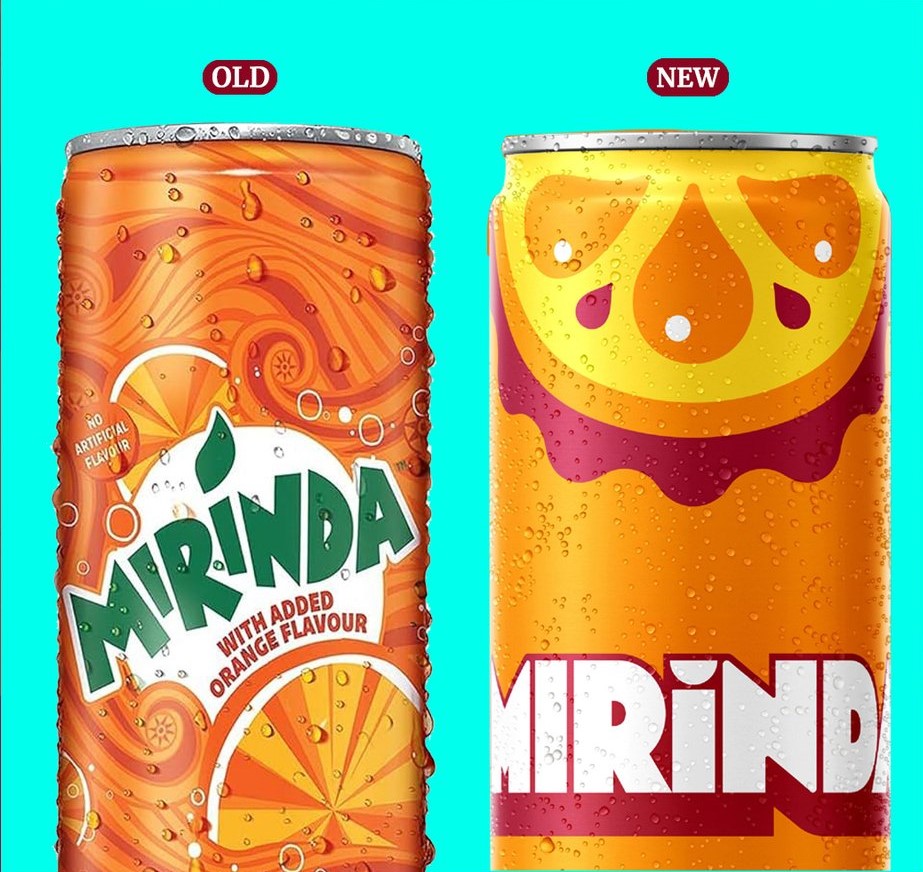




Mirinda launched its “Smile Please” global platform on 28 April 2026 alongside a refreshed visual identity that transforms semi-circles into smiles across every touchpoint.
Developed in-house by PepsiCo’s Design and Innovation team, the rebrand positions the smile as a “superpower” that lifts mood and inspires others. It shifts the brand from product-led messaging to emotional impact. The new logo features brighter green, sharper corners, and cleaner lines, while packaging uses oversized fruit graphics built from semi-circle shapes. High-contrast palettes differentiate 50-plus flavours within a unified system. The bet is clear: Gen Z consumers facing stressful routines will choose a brand that promises joy over one that simply offers refreshment.
The design system shows how constraint drives creativity. The semi-circle becomes the organising principle across all visuals, from fruit illustrations to layout elements. This repetition creates a distinct signature that scales across more than 200 markets. When executed consistently at this level, design becomes a competitive advantage, not just decoration.
The timing reflects a response to cultural fatigue. The campaign asks how a brand can offer a real “break” in a world that never disconnects. Mirinda’s answer mirrors KitKat’s Break positioning, but through design rather than function. Where KitKat used a Faraday cage to block signals, Mirinda uses visual psychology to trigger a smile. Both address the same tension, constant digital noise, through different levers.
The “Smile Chain” influencer activation leans on peer validation. Instead of scripted promotion, it encourages creators to spark a chain reaction of positivity. The success depends on authenticity. If influencers engage creatively, it resonates. If not, it risks becoming another performative campaign.
This is Mirinda’s second major rebrand in three years. The 2023 “Making an M-pact” platform focused on self-expression and resisting conformity. The shift to simple happiness signals a strategic pivot. Rebellion can feel exhausting. Joy feels accessible. The brand is choosing ease over tension.
Eugene Willemsen, CEO of International Beverages at PepsiCo, framed it as an evolution of self-expression into something more playful and relevant. The willingness to pivot this quickly suggests the previous positioning did not fully land or that consumer sentiment moved faster than expected.
For Nigerian marketers, the lesson is in simplification. With over 50 flavours, product complexity can overwhelm. A strong emotional platform reduces decision friction. Consumers stop choosing between flavours and start choosing the feeling the brand represents.
The retro-modern aesthetic reinforces this. Nostalgia alone feels dated, while pure modernism can feel cold. Combining both creates familiarity without losing relevance.
The real test is commercial. Design can attract attention, but sales depend on price, taste, and distribution. Mirinda competes with Fanta and local alternatives in price-sensitive markets. A strong identity must still convert at the shelf.
The scale of rollout, across 200 markets simultaneously, highlights PepsiCo’s operational strength. Coordinating packaging, media, and retail execution at that level is a moat smaller competitors cannot easily replicate.
Whether “Smile Please” lasts longer than the previous platform depends on market response. Mirinda is betting that smiles outperform rebellion. Consumers will decide if that bet holds or forces another reset before the decade ends.
ALSO WATCH:MARKETING EDGE ONTV



Comment
No comments found.