
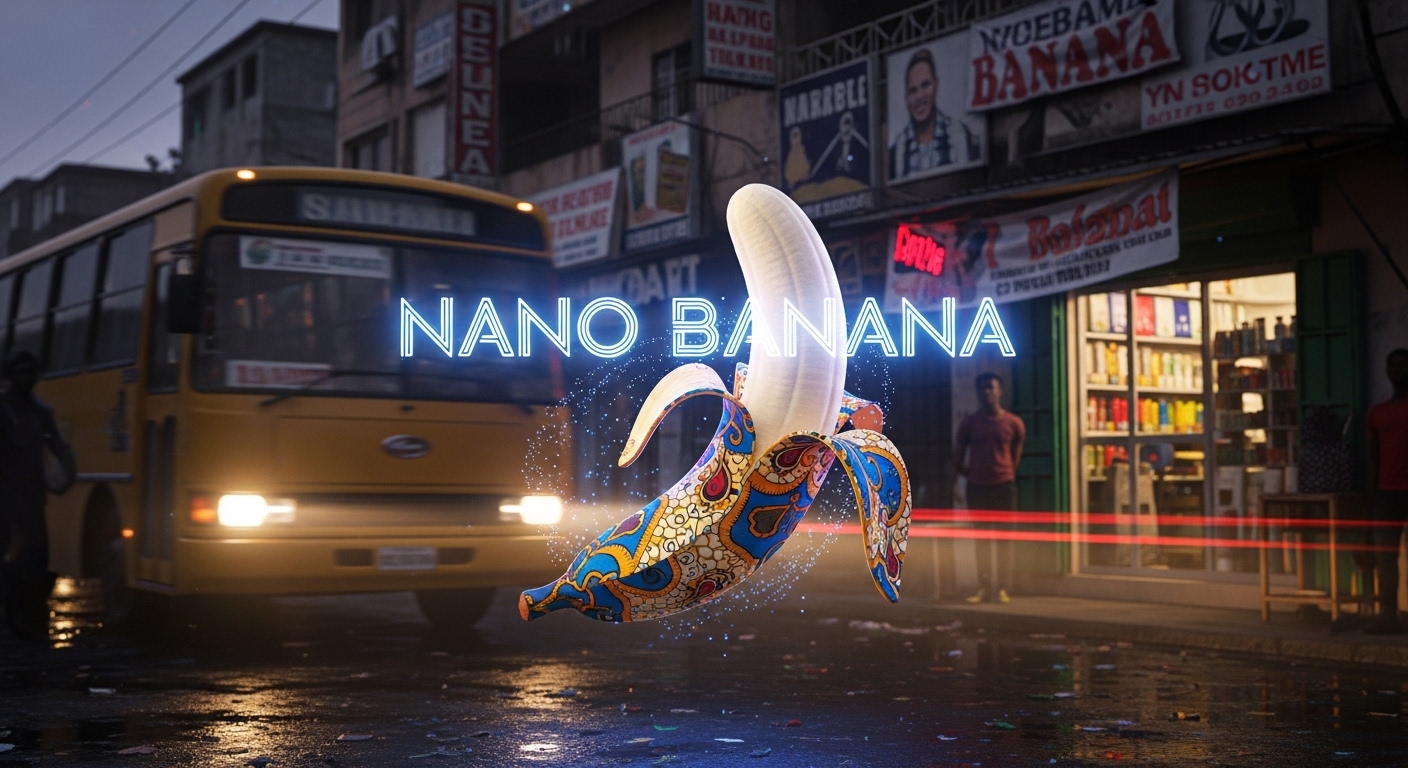




Google has launched Nano Banana 2 in Nigeria, an AI image generation tool integrated directly into Google Search and Google Lens, creating professional-looking images in seconds.
Type what you want. Get a finished design. No software. No subscription. No designer.
Taiwo Kola-Ogunlade, Google’s Communications and Public Relations Manager for West Africa, positioned the launch as creative empowerment: “Nigerians are some of the most creative people in the world, and today we’re expanding these tools to give them a new way to express that.”
Anyone with a smartphone can now create the kind of marketing visuals that used to require hiring a designer. For Nigerian advertising agencies, freelance creatives, and the ecosystem of designers charging N20,000 to N100,000 for basic flyers and social media graphics, this represents immediate disruption. The question isn’t whether AI changes the creative industry. It’s how fast and who survives.
What Nano Banana 2 actually does
The tool runs on Gemini 31. Flash Image, accessible through the Google App or mobile browser. Users describe what they want in natural language. The AI generates images within seconds, including realistic depictions of Nigerian landmarks, consistent character designs across multiple images, and readable text insertions for flyers, greeting cards, and social media posts.
The Nigerian applications are immediate. A small business owner in Yaba can visualise a storefront redesign without hiring an architect or designer. A startup founder can create pitch deck visuals without paying a creative agency. A church in Surulere can design Sunday service flyers without commissioning a graphic designer. A politician can generate campaign posters without a media team.
The immediate cost disruption
Nigerian graphic design pricing operates in tiers. Entry-level designers charge N5,000 to N15,000 for basic social media graphics. Mid-tier freelancers command N20,000 to N50,000 for flyer designs, event posters, and simple branding. Established designers and small agencies charge N100,000 and up for comprehensive projects.
Nano Banana 2 attacks the bottom two tiers aggressively. Why pay N15,000 for a birthday flyer when you can generate dozens of options for free in ten minutes? Why hire a N30,000 designer for event posters when AI produces acceptable results instantly?
Small businesses operating on tight margins will shift fastest. The provision store owner who previously paid a designer N10,000 for promotional graphics twice a year now generates them for free whenever needed. The multiplication effect matters: instead of two designs annually due to budget constraints, they create twenty because the cost drops to zero.
Freelance designers relying on the volume of small projects face compression. If the market for N5,000 to N20,000 jobs shrinks by even 30 per cent, hundreds of entry-level designers lose their primary income source. The designers who built businesses on quick turnarounds of simple work, birthday cards, event flyers, and basic social posts see demand evaporate.
Advertising agencies face different pressures. Large brands won’t immediately replace creative teams with AI. But the clients paying N200,000 for campaign concepts that include social media graphics, posters, and presentation decks will start questioning why half that budget goes toward visuals that AI can generate. Account managers will field questions about whether AI-generated alternatives could reduce project costs creative agency.
Where AI fails spectacularly
But before designers panic entirely, Nano Banana 2 has clear limitations that protect certain categories of creative work.
Brand strategy remains entirely human. The AI can generate a logo if you describe it, but it can’t conduct brand audits, competitive analysis, or strategic positioning work. It can’t tell a startup whether its visual identity aligns with its target market. It can’t navigate the psychology of Nigerian consumer segments or advise whether red or blue tests better for trust signals in financial service advertising.
Cultural nuance escapes algorithms. An AI trained on global datasets might generate technically competent Nigerian imagery, but it won’t understand the difference between Lagos corporate aesthetics and Abuja political campaign visual language. It won’t know which cultural symbols resonate versus which feel inauthentic. It won’t catch when an image accidentally references sensitive tribal or religious contexts.
Client management is irreplaceable. Designers who succeed don’t just create visuals. They manage expectations, interpret vague briefs, navigate revision cycles diplomatically, and deliver psychological reassurance that the final products will work. A business owner using Nano Banana 2 gets output, not consultation. They’re responsible for knowing what works, making decisions without expert guidance, and living with mistakes.
Consistency across complex brand systems requires human oversight. While Nano Banana 2 can maintain consistent characters across images, full brand identity systems, logo, colour palettes, typography hierarchies, and application across dozens of touchpoints, need human coordination. The AI generates individual pieces. It doesn’t build cohesive systems or maintain brand guidelines over the years.
Print production knowledge matters. Generating an image that looks good on screen doesn’t mean it prints correctly. Colour profiles, resolution requirements, bleed specifications, and printer limitations require expertise that AI doesn’t replace. Designers who understand production save clients from expensive printing mistakes.
Creative direction for campaigns needs strategic thinking. An AI can generate ten concept directions if prompted, but it can’t evaluate which concept aligns with campaign objectives, budget realities, and media channel requirements. It can’t pitch ideas to clients with the storytelling and persuasion that wins buy-in.
The survival strategies for creatives
Nigerian designers have two paths: compete on what AI can’t do, or become AI-augmented professionals who deliver faster and cheaper than competitors, still working manually.
Moving upmarket is the obvious first strategy. Stop taking N10,000 flyer jobs that AI now handles. Focus on brand strategy consulting, creative direction, complex multi-channel campaigns, and work requiring cultural expertise. Position as a strategist who happens to execute visually rather than an executor who happens to think strategically.
Specialisation in AI-resistant categories protects income. Designers focusing on motion graphics, video editing, complex illustration, or three-dimensional rendering face less immediate AI competition. The technology will eventually reach these categories, but current tools target static image generation.
Becoming AI-augmented allows competitive pricing while maintaining quality. Designers using Nano Banana 2 for initial concept generation, then adding human refinement, cultural adjustment, and brand consistency, deliver faster than purely manual workflows. They can undercut competitors on price while maintaining margin because AI handles the time-intensive foundation work.
Building consultative client relationships creates switching costs. Clients who view designers as trusted advisors rather than service providers don’t replace them with AI even when technically possible. The relationship value, strategic guidance, and psychological security justify continuing payment.
Agencies must integrate AI rather than resist it. The firms pretending AI doesn’t change workflows lose to competitors who use AI to reduce junior designer hours while focusing senior talent on strategy. Smart agencies use AI as a productivity multiplier, not a replacement threat.
The agency calculation
Advertising agencies face an uncomfortable decision. Nano Banana 2 reduces the billable hours required for many projects. A campaign that previously needed 40 hours of design work might need 15 hours when AI handles initial generation and junior designer tasks. That’s good for efficiency. It’s terrible for revenue if agencies bill by the hour or charge based on effort rather than value.
Agencies structured around large creative departments with multiple junior designers face pressure. If AI eliminates the need for three junior positions, does the agency maintain them at lower margins or reduce headcount? The decision affects not just current staff but the talent pipeline. If entry-level positions disappear because AI handles junior work, where do senior designers come from in five years?
The value-based pricing model becomes essential. Agencies must shift from “we spent 40 hours creating this campaign” to “this campaign will generate N50 million in revenue for you.” When pricing reflects outcome value rather than effort input, AI productivity improvements increase margin rather effort input, AI productivity improvements increase margin rather than threatening revenue.
Client education creates temporary protection. Many Nigerian brands don’t understand creative work beyond “make it look good.” Agencies explaining why AI-generated visuals work for some applications but fail for comprehensive brand strategy can maintain pricing for a while. But eventually, sophisticated clients will demand that AI productivity gains translate to cost savings.
What happens next
The transition won’t be an immediate collapse. Established designers with strong client relationships won’t lose all work by March. But the trajectory is clear. Entry-level design work commoditises. Pricing compresses for basic services. Agencies restructure around similar creative teams augmented by AI tools.
The designers who thrive will be those who positioned themselves as strategic partners before AI forced the shift. The ones who built consulting practices, developed cultural expertise, and created client dependencies beyond pure execution already operated in the AI-resistant tier.
The designers who struggle will be those whose value proposition was speed and affordability on simple work. When free AI is faster, affordability isn’t competitive. When quality reaches “good enough” for most use cases, premium execution skills don’t command premium prices for basic projects.
Nigerian advertising agencies have perhaps two or three years before sophisticated clients routinely question why campaigns cost what they do when components are AI-generatable. The agencies preparing now restructure around strategic value, integrating AI workflows, and moving upmarket to complex brand challenges, position themselves as AI partners rather than AI casualties.
For the broader Nigerian creative economy, Nano Banana 2 represents the first wave. Image generation is just the beginning. Video generation, motion graphics, and eventually full campaign concepting will follow. Each technological step compresses another category of creative work.
The question for Nigerian agencies isn’t whether to adapt. It’s whether they adapt before clients force the issue or after revenue decline makes restructuring desperate rather than strategic. Google just gave every Nigerian a free graphic designer. The ones who get paid will be the ones who offer what free can’t provide.
ALSO WATCH MARKETING EDGE ONTV


Comment
No comments found.