
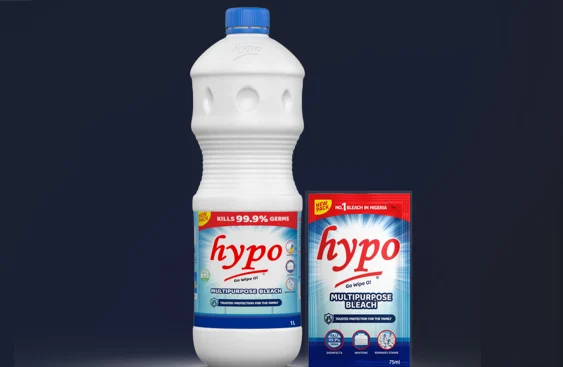


Hypo Bleach broke years of silence, publicly addressing what its marketing team had long avoided: it acknowledged that its household cleaning product had become associated with death, for social media clout.
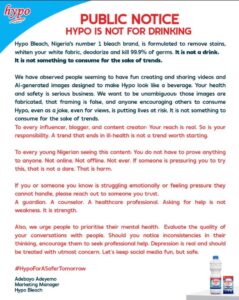
On March 1, 2026, the statement, signed by Marketing Manager Adebayo Adeyemo, addressed influencers faking Hypo consumption for social media engagement and warned young Nigerians that “anyone encouraging others to consume Hypo, even as a joke, even for views, is putting lives at risk.”
The statement came four days after influencer King Mitchy appeared to drink Hypo during a TikTok livestream, faked her death, then resurrected. In the same vein, VeryDarkMan parodied the stunt with his own fake Hypo consumption and mock burial.
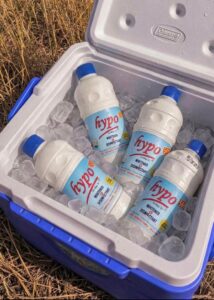
Shortly after the display by these social media influencers, similar content flooded Nigerian social media. People posted photos holding Hypo bottles to their lips. AI-generated images made the bleach look like a beverage.
For Tolaram Group, Hypo’s parent company, the crisis represented a collision between two problems the brand had separately ignored for years: actual suicides using their product, and now influencers trivialising those deaths for engagement. The March 1 response offers lessons in both effective crisis communication and the limits of statements without strategy.
Why Hypo stayed silent until influencers forced visibility
Hypo’s association with suicide in Nigeria predates the King Mitchy incident by years. Lagos University Teaching Hospital data from 2018 showed 62.1 per cent of suicide cases involved poison, most often Sniper insecticide or Hypo bleach. Nigeria ranks seventh in Africa for suicide rates, with ages 15-29 at the highest risk.
University students facing exam failures, young people dealing with heartbreak, individuals overwhelmed by depression, Hypo was accessible, affordable, and universally understood as dangerous. The product costs under ₦500 and sits in nearly every Nigerian bathroom. For someone in crisis, it requires no planning and no purchase.
Through years of news reports connecting Hypo to student deaths and relationship-driven suicides, the brand maintained complete silence. No public campaigns addressing mental health. No partnerships with suicide prevention organisations. No warning labels featuring crisis hotlines. From a brand management perspective, this silence made sense. Acknowledging the association might amplify it. Every statement generates media coverage, potentially informing more people about the method.
But silence as a strategy only works when the association remains relatively invisible. The King Mitchy incident destroyed that invisibility. When millions watch an influencer fake drinking Hypo on a livestream, when copycat content goes viral, when media coverage explicitly connects the brand to death stunts, silence stops being neutral risk management. It becomes brand liability.
What Hypo’s statement got right
The March 1 response demonstrates several crisis communication strengths worth studying.
First, unambiguous messaging. “Hypo is not a drink” leaves zero room for interpretation. The statement explicitly condemns videos and AI-generated images, making the product look like a beverage. In crises where brand reputation is at stake, clarity matters more than polish.
Second, audience segmentation. The statement addresses influencers separately from young people seeing the content. Influencers get direct warnings about responsibility: “Your reach is real. So is your responsibility.” Young people get reassurance: “You do not have to prove anything to anyone. Not online. Not offline. Not ever.” Different stakeholders require different messages. Hypo recognised this.
Third, safety framing over defensive positioning. While the statement protects brand reputation, the primary emphasis focuses on consumer well-being rather than legal liability. This positions Hypo as socially responsible rather than reactive. The distinction matters for brand perception.
Fourth, speed without appearing rushed. Four days after the incident, Hypo has time to craft proper messaging while still feeling responsive. Too fast suggests panic. Too slow suggests indifference. The timing worked.
The hashtag #HypoForASaferTomorrow provides a consistent messaging hook for future communications. If Hypo continues engagement on this issue, the hashtag creates thematic continuity.
Where the response falls short strategically
Despite tactical execution competence, the statement reveals strategic limitations that reduce long-term brand protection value.
Most critically, it offers no concrete commitments. The brand doesn’t announce partnerships with mental health organisations, funding for campus counselling programs, or warning labels featuring suicide hotlines. It asks influencers to be responsible and young people to prioritise mental health without committing resources to make those outcomes more likely. Slogans without strategy feel performative.
The timing raises questions about brand priorities. Hypo addressing the issue in March 2026, years into the suicide crisis, but immediately after viral influencer stunts, suggests the brand responds to social media embarrassment more urgently than to actual deaths. Whether fair or not, this perception damages brand credibility.
The statement doesn’t address enforcement or consequences. How does Hypo plan to prevent future influencer stunts? Will the brand pursue legal action against creators encouraging consumption? Will it partner with TikTok and Instagram to classify such content as prohibited? The statement condemns behaviour without outlining what happens to those who continue.
For FMCG brands studying this response, the lesson is clear: statements manage immediate perception but don’t build long-term brand equity around responsibility. Hypo’s response stops the bleeding. It doesn’t position the brand as a leader in addressing the underlying crisis.
The marketing implications nobody’s calculating
Every future Hypo advertisement, every product placement, every brand message now exists in the context of suicide association and social media mockery. The brand can’t run standard cleaning efficacy campaigns without consumers remembering King Mitchy’s fake death. Every bottle purchased carries mental associations with tragedy and performance.
This creates several marketing challenges. Traditional advertising emphasising product benefits feels tone-deaf when the product is culturally understood as dangerous. Influencer partnerships become complicated when influencers recently used the product for death stunts. Social media engagement carries risk when every post might attract comments about suicide or fake death challenges.
Competitor brands face similar exposure. Jik, Klin, and other bleach manufacturers market nearly identical products with identical household presence. Any of them could become the next social media prop. The brand that moves first on mental health advocacy creates competitive differentiation while others remain vulnerable.
This represents an opportunity disguised as a crisis. If Hypo commits sustained resources to mental health programs, partners with universities on suicide prevention, and creates actual support infrastructure, the brand association shifts from “the bleach in death stunts” to “the brand addressing Nigeria’s youth mental health emergency.” That positioning creates differentiation; no cleaning efficacy claim can match.
The alternative is maintaining the current strategy: issue statements when crises force visibility, return to silence between incidents, and hope algorithm changes reduce association over time. This path is cheaper and operationally simpler. It also guarantees that the next viral incident generates identical brand damage requiring another reactive statement.
What FMCG brands should learn from this
Household product brands operate in a new environment where social media can transform any product into crisis content overnight. The Hypo situation offers several strategic lessons.
First, silence expires when association becomes visible. Hypo’s years of quiet risk management ended the moment influencers made the association impossible to ignore. Brands can’t wait for viral incidents to force a response. Proactive positioning on sensitive issues protects better than reactive statements.
Second, statements without commitments feel performative. Consumers and media distinguish between brands genuinely addressing problems and brands managing perception. Hypo’s statement demonstrates competent crisis communication but doesn’t signal strategic commitment. Future brand protection requires actual programs, not just messaging.
Third, competitor vulnerability creates a first-mover advantage. Every bleach brand faces an identical risk. The brand that funds mental health programs, implements warning labels, and partners with universities differentiates itself while competitors remain exposed. Corporate social responsibility becomes a competitive strategy.
Fourth, a crisis creates a repositioning opportunity. Hypo can’t change its product’s accessibility or chemical properties. But it can change brand positioning from pure household utility to household utility plus social responsibility. That positioning sustains through future incidents because the brand demonstrates consistent values.
Fifth, enforcement matters as much as messaging. Asking influencers to be responsible without consequences for irresponsibility doesn’t change behaviour. Brands need legal strategy, platform partnerships, and clear consequences for content creators who weaponize products for engagement.
The bigger pattern for Nigerian brands
The Hypo crisis reflects broader challenges Nigerian FMCG brands navigate in 2026. Social media creates unprecedented brand risk velocity. A product operating normally for decades can become crisis content within hours. Traditional brand management, assuming controlled messaging environments, no longer applies.
Nigerian brands must develop a crisis response capability that matches social media speed while maintaining strategic coherence. This requires monitoring systems detecting emerging brand associations before they become viral, response protocols enabling rapid statement deployment without appearing panicked, and strategic frameworks determining when silence protects versus when visibility demands engagement.
The brands succeeding in this environment treat corporate social responsibility as brand protection infrastructure rather than an optional enhancement. Funding mental health programs, partnering with NGOs, implementing warning systems, these aren’t charitable activities separate from marketing. They’re brand equity investments that protect against viral association damage.
For Hypo specifically, the path forward determines whether the brand becomes a case study in effective crisis management or a cautionary tale about reactive communication without strategic follow-through. The March 1 statement demonstrates tactical competence. What happens next determines whether acknowledgement leads to action or just better prepared statements for the next incident.
The bottom line for marketers
Hypo’s crisis illustrates a fundamental shift in FMCG brand management. Products no longer exist in controlled retail environments where brand messaging dominates consumer perception. They exist in social media ecosystems where any product can become a meme, a challenge, a crisis, or all three simultaneously.
Marketing strategies built for controlled messaging don’t survive viral velocity. Brands need crisis response infrastructure as sophisticated as their advertising campaigns. They need monitoring systems, rapid response protocols, legal strategies, platform partnerships, and most importantly, genuine commitments to addressing problems rather than just managing perception.
The brands that thrive won’t be those that issue the best statements when crises erupt. They’ll be the brands that build protective infrastructure before crises force visibility, that position themselves as solution leaders rather than problem deniers, and that recognise corporate social responsibility as a competitive advantage rather than a cost centre.
Hypo’s statement on March 1, 2026, represents necessary crisis management. Whether it represents the beginning of strategic transformation or just another reactive statement before the next incident remains to be seen. For Nigerian FMCG brands watching this unfold, the lesson is clear: build infrastructure now, before your product becomes the next social media crisis. Because in 2026, every household product is one viral moment away from needing a response strategy.
ALSO WATCH MARKETING EDGE ONTV



Comment
No comments found.