
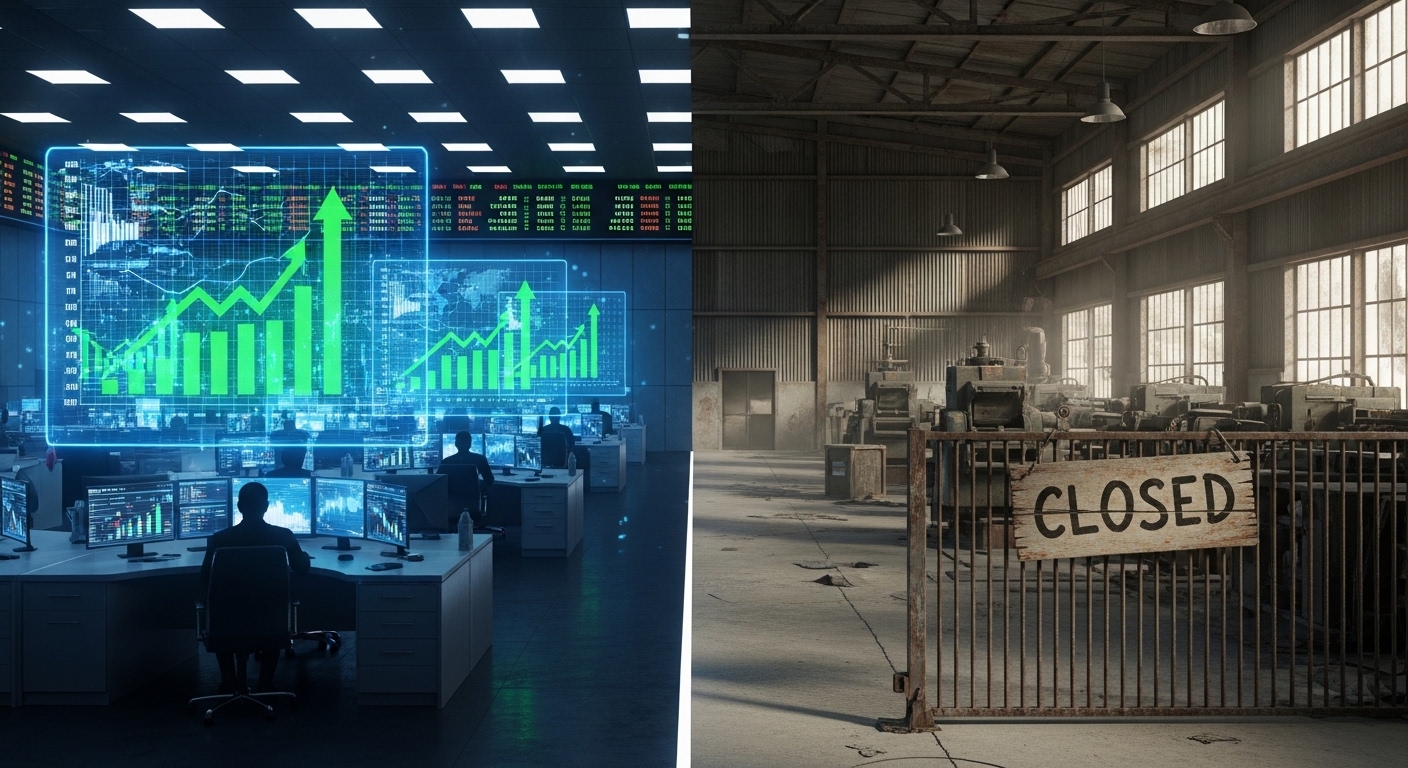


Nigeria attracted $23.22 billion in foreign capital during 2025, nearly six times the $3.91 billion received in 2023. Boardrooms celebrated. Central Bank officials praised macroeconomic reforms. Financial markets rallied.
Meanwhile, factories shut down at a rate of two per day. Manufacturing investment collapsed 51.44 per cent across two years, falling from $1.59 billion in 2023 to $772.45 million in 2025. The sector that once represented nearly half of all foreign inflows now captures 3.33 per cent. And investors who might have built production lines instead bought treasury bills.
This is what capital reallocation looks like when the entire economy pivots from making things to trading paper. Nigeria didn’t lose foreign investor interest. It redirected that interest toward assets that generate returns without building factories, hiring workers, or producing goods that can’t be exported.
The divergence reveals an uncomfortable truth about Nigeria’s investment climate: reforms that make financial markets attractive don’t automatically make manufacturing viable. Portfolio investments surged to 85.14 per cent of total inflows during the fourth quarter of 2025. The banking sector alone captured 59.75 per cent of capital. Manufacturing received 4.79 per cent, enough to expand maybe three medium-sized facilities in a country of 200 million people.
Manufacturing’s share of total capital importation tells the story in three data points. In 2023, the sector captured 49.73 per cent of foreign inflows, a dominant position suggesting investors saw production as a strategic priority. By 2024, that share had fallen to 11.58 per cent. By 2025, it reached 3.33 per cent. The collapse wasn’t gradual erosion. It was structural abandonment.
Foreign investors made a calculated decision. Nigerian treasury bills offer double-digit returns with minimal operational complexity. Government securities provide dollar-denominated yields without navigating power failures, port delays, or security challenges. Banking sector investments generate returns measured in quarters rather than decades required to build competitive manufacturing operations.
Manufacturing demands a different investment psychology. Production facilities require stable electricity, functioning logistics, predictable policy environments, and patient capital willing to absorb losses whilst building scale. Nigeria offers none of these consistently enough to justify capital commitment when alternative assets deliver comparable returns with a fraction of operational risk.
“Foreign investors are wary of long-term manufacturing projects due to high operational risks,” explains Segun Ajayi-Kadir, Director-General of Manufacturers Association of Nigeria. “Unstable power, costly logistics, port inefficiencies, and policy uncertainty make Nigeria less competitive compared to sectors with quicker returns.”
The infrastructure deficit alone would discourage manufacturing investment even if everything else functioned perfectly. Nigerian manufacturers pay premium prices for diesel generators because grid power remains unreliable. They absorb logistics costs that can exceed production costs because roads, rails, and ports operate below capacity or efficiency standards that make exporting viable. They navigate customs processes that delay raw material imports, forcing them to maintain inventory levels that tie up working capital.
These aren’t new problems. What’s changed is investment calculus. When Nigeria’s financial markets offered modest returns and manufacturing showed growth potential, investors tolerated operational complexity. Now that financial assets deliver strong returns with minimal friction, the relative attractiveness of manufacturing has collapsed.
The Manufacturers Association of Nigeria quantified the damage. Manufacturing contribution to GDP fell from 29.9 per cent in 1981 to 8.2 per cent in 2024. Real growth in the sector declined from 14.7 per cent in 2014 to 1.2 per cent in 2024. By 2023, 767 manufacturing companies had shut down. During 2024 alone, 18,000 manufacturing jobs disappeared.
Those jobs won’t return through portfolio investments. Treasury bills don’t employ factory workers. Banking sector growth doesn’t train production engineers. Financial market expansion doesn’t create export capacity. The capital flowing into Nigeria is real. The returns generated benefit investors. But that capital isn’t building the economic foundation required for sustained employment growth, technology transfer, or export diversification.
President of Lagos Chamber of Commerce and Industry, Leye Kupoluyi, identified the strategic implication: “The figures indicate the country’s recovery is driven mainly by short-term financial flows, rather than by long-term productive investment. This carries both encouraging and troubling implications.”
The encouraging part: Nigeria can attract capital when macroeconomic conditions stabilise and financial markets function efficiently. The troubling part: that capital avoids the sectors that create durable employment, develop industrial capabilities, and reduce import dependency.
For Nigerian brands and marketers, the manufacturing collapse creates a paradox. Consumer market remains vibrant. The middle class continues spending. E-commerce and fintech sectors thrive on transaction volumes that suggest healthy domestic demand. But the underlying production capacity that could serve that demand with Nigerian-made goods is shrinking.
This matters because consumption funded by imports rather than domestic production creates persistent trade imbalances, currency pressure, and vulnerability to external shocks. When Nigerian consumers buy products manufactured elsewhere, the economic multiplier effects, jobs created, skills developed, and supply chains activated, occur in those countries rather than in Nigeria.
The strategic question isn’t whether Nigeria should accept portfolio investments. Those inflows provide liquidity, support financial system stability, and enable capital market development. The question is whether Nigeria can create conditions that make manufacturing investment competitive with financial assets that offer comparable returns with dramatically lower operational complexity.
That requires addressing structural bottlenecks that have persisted for decades: power supply, logistics efficiency, port operations, policy stability, and security conditions. These aren’t problems that macroeconomic reforms alone can solve. They require infrastructure investment, institutional capacity, and sustained political commitment that extends beyond election cycles.
Until those conditions improve, expect capital to keep flowing toward assets that generate returns without building factories. Nigeria will continue attracting billions in foreign investment whilst the manufacturing sector continues contracting. The country will grow richer in financial terms whilst becoming weaker in productive capacity.
The $23 billion capital boom ignored the factories because factories require more than capital. They require infrastructure, stability, and patient investors willing to absorb complexity that financial assets don’t demand. Nigeria reformed enough to attract portfolio investors. It hasn’t reformed enough to attract manufacturers. And the gap between those two achievements will determine whether current capital inflows represent genuine economic transformation or temporary financial arbitrage that ends when returns normalise globally.
Manufacturing contribution to the Nigerian economy has fallen from nearly 30 per cent to 8 per cent over four decades. The recent investment collapse accelerates that decline. Reversing it requires more than celebrating capital inflows. It requires building an industrial ecosystem that makes production competitive, sustainable, and strategically attractive to investors who currently find treasury bills more appealing than factory construction.
Until then, Nigeria’s $23 billion capital boom will keep ignoring the factories. And the factories will keep closing.
ALSO WATCH:MARKETING EDGE ONTV



Comment
No comments found.