
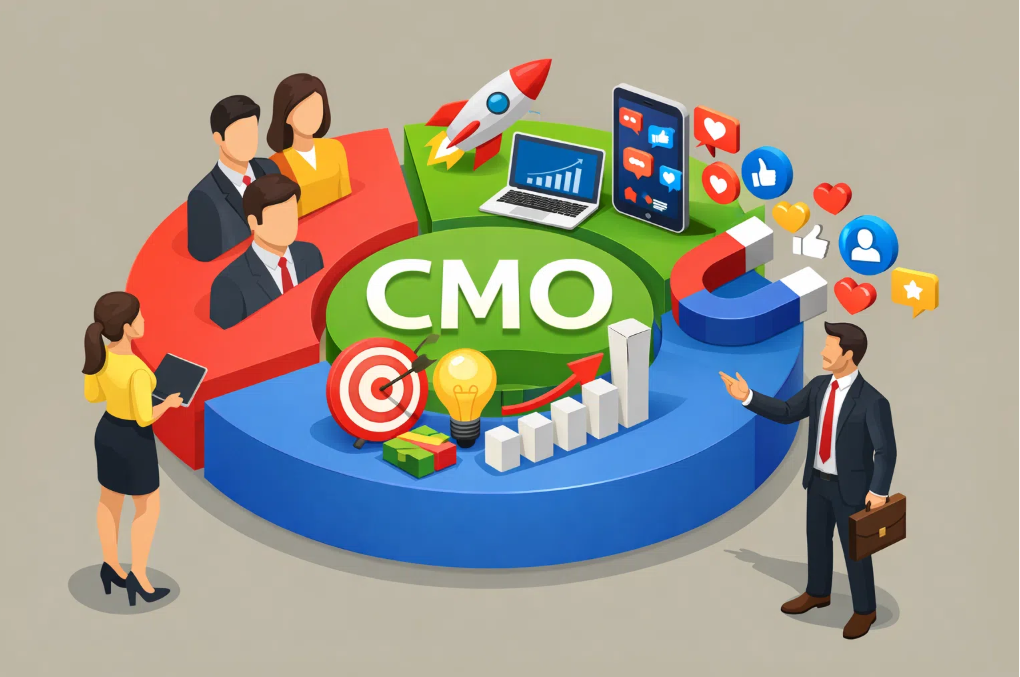


Marketing leadership is facing a defining moment as artificial intelligence, rising growth expectations and changing customer demands compel businesses to reconsider the responsibilities traditionally assigned to the Chief Marketing Officer (CMO).
While titles such as Chief Growth Officer, Chief Customer Officer and Chief Experience Officer are gaining ground, the shift raises a deeper question about whether companies are simply renaming executive positions or fundamentally restructuring how marketing contributes to business performance.
For Uchenna Innocent, Managing Partner and Chief Executive Officer of Radoss Agency, the growing diversity of executive titles reflects a need to distribute responsibilities more deliberately, allowing professionals to concentrate on specialised functions rather than stretching the CMO role across an expanding range of business demands.
Speaking at the 2026 MARKETING EDGE Awards, where he received the Digital Transformation Personality of the Year award, Innocent argued that the relationship between marketing, technology and business strategy has changed so significantly that organisations must reconsider how they define leadership responsibilities.
Drawing on his background in digital, marketing and technology, he maintained that professionals can no longer depend on established methods alone but must continually adapt their expertise to match the direction of their industries.
Rather than viewing digital transformation as a straightforward process of introducing new tools, he emphasised the importance of understanding how technology can address organisational needs and create meaningful business value.
This philosophy also informs his position on the emergence of specialised executive roles, which he sees as a response to the growing complexity of responsibilities within modern organisations.
Explaining the distinction, Innocent argued that distributing the functions traditionally associated with the CMO role can help businesses establish clearer responsibilities and prevent individual executives from carrying an excessive range of expectations.
“I would say it’s more of decentralising what the CMO role needs to be and reducing the burden into more defined functions. The industry is changing. It’s no longer linear, and there’s a need to evolve with it.
He further said that his approach centres on using technology to make sense of business challenges and develop practical solutions. To illustrate his point, the digital expert cited his own designation as Chief Digital Architect, explaining that the title communicates his specific contribution more accurately than conventional executive labels might.
Although he could have chosen to identify himself as a Chief Executive Officer or Chief Marketing Officer, he said those titles would not necessarily convey the particular value he brings to his business.
For Innocent, the distinction goes beyond personal branding because a clearly defined executive role can establish ownership of a specialised function and make its contribution to organisational performance easier to identify.
Consequently, he believes businesses should examine the responsibilities attached to each position rather than assume that established titles remain sufficient to accommodate every emerging demand.
His argument carries particular weight as marketing executives face increasing pressure to demonstrate how their activities translate into revenue, customer acquisition, pipeline development and sustainable growth.
Across the business environment, marketing is moving beyond the execution of campaigns and the management of brand communications towards a more direct role in commercial decision-making.
As a result, senior marketing professionals are increasingly expected to combine strategic oversight with practical execution, communicate performance in business terms and connect marketing investments to measurable organisational outcomes.
However, the expanding remit also presents a challenge: businesses must determine whether a single executive can effectively oversee brand strategy, customer experience, digital transformation, data management and growth without compromising the depth of attention each function requires.
Against this backdrop, the emergence of specialised executive positions offers one possible response, although their value depends on whether organisations assign them distinct responsibilities and meaningful accountability.
Amos Oladele, Managing Director and Editor-in-Chief of MARKETING EDGE, similarly rejects the notion that the changing nomenclature represents a superficial corporate trend, arguing that the development reflects wider changes in the economic environment.
Responding to the emergence of titles such as Chief Experience Officer and Chief Customer Officer, Oladele stressed that the distinctions between these positions and the traditional CMO role must be understood in terms of their respective functions.
“No, no, no, no. It’s beyond a mere change in titles,” he said, explaining that the shift speaks to the evolution of the economic landscape and the changing demands placed on businesses.
According to Oladele, the Chief Marketing Officer and Chief Experience Officer do not perform identical functions, even when their responsibilities intersect within an organisation.
His position reinforces the need for businesses to distinguish between managing marketing activities and overseeing other specialised areas, including customer experience, rather than treating the titles as interchangeable alternatives. Indeed, the precise responsibilities of each executive depend on the organisation’s structure, commercial priorities and approach to serving its customers.
For companies that establish both positions, clearly separating their mandates becomes essential to preventing duplication, improving coordination and ensuring that each executive contributes to the wider business strategy.
Meanwhile, artificial intelligence is adding another dimension to the debate by changing how marketing teams gather insights, analyse performance, forecast demand and engage prospective customers.
Although AI can accelerate these activities, its growing capabilities also place greater emphasis on human judgement, data literacy and governance, particularly when professionals must assess the accuracy of generated insights and recognise when human intervention is necessary.
Similarly, businesses must reconsider how they organise information and communicate their offerings as AI-powered search tools and digital agents increasingly influence how audiences discover and evaluate products and services.
These developments are widening the range of capabilities expected from marketing leaders, making it more difficult to separate traditional marketing responsibilities from technology, customer intelligence and broader business strategy.
Nevertheless, the growing importance of AI does not automatically diminish the CMO’s relevance. Instead, it strengthens the case for leadership structures that combine technological competence with commercial understanding, customer insight and strategic judgement.
For some organisations, the CMO may remain the executive responsible for integrating brand positioning, marketing performance and growth objectives, while other businesses may assign customer experience, digital architecture or growth management to separate specialists.
The appropriate model will depend on the organisation’s scale, priorities and operational requirements, rather than on the popularity of particular executive titles.
Equally important, businesses must ensure that introducing new positions leads to clearer decision-making and stronger collaboration instead of creating additional management layers without corresponding value.
As marketing continues to absorb new technologies and broader commercial expectations, businesses must decide which responsibilities belong together, which require dedicated expertise and how each executive should contribute to measurable results.
So,today, the question facing the industry is not simply whether the traditional CMO will survive the rise of new executive titles, but whether organisations can redesign marketing leadership to reflect the realities of modern business.




Comment
No comments found.