
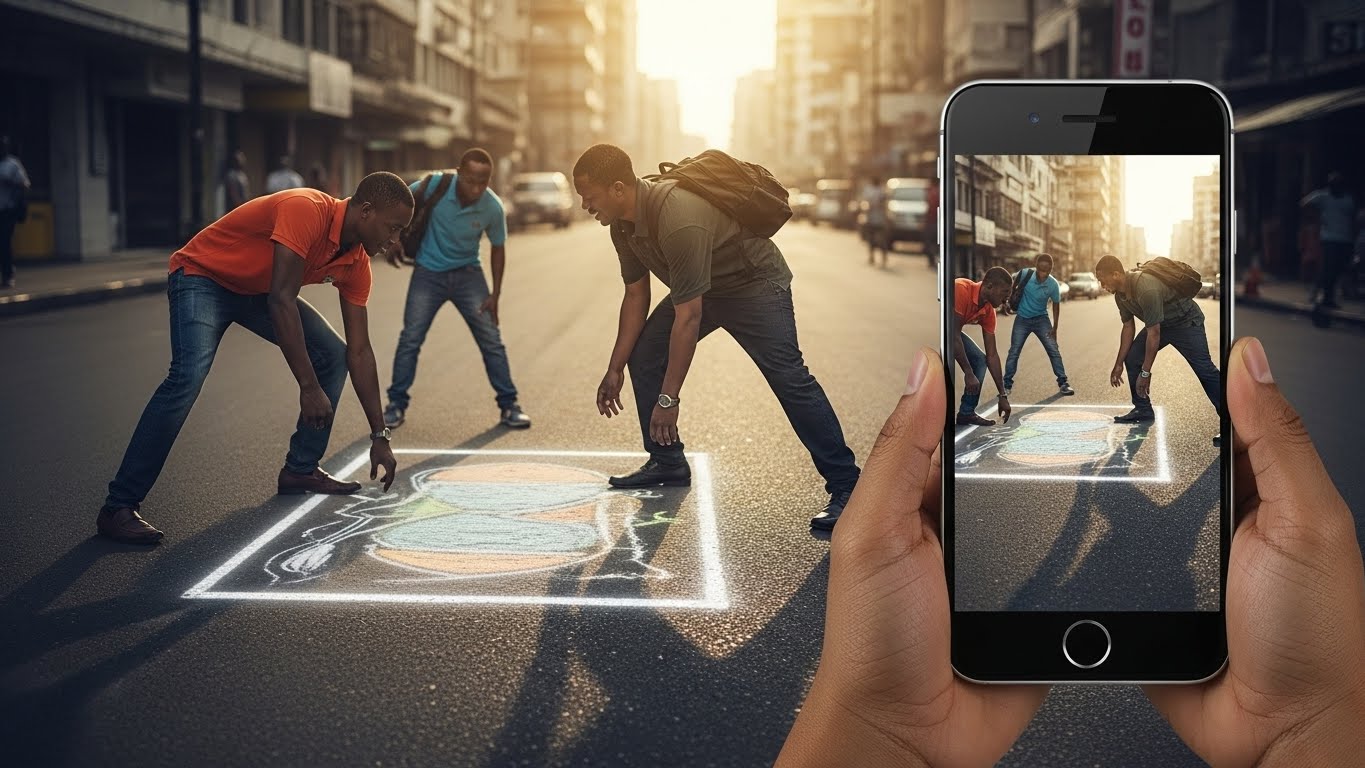


On a crowded Lagos street, a flash mob bursts into synchronized dance. Chalk art appears overnight in the middle of Balogun market, not as advertising but as a riddle pointing to a new drink. A bus-stop billboard looks ordinary until nightfall, when a countdown suddenly lights up the frame. You take a photo. You post it. Within hours, half of your timeline is discussing it.
This is guerrilla marketing. Not the outdated tactics of the early 2000s, but a revived, energetic strategy that cuts through noise, triggers emotion, and thrives inside Nigeria’s bustling street-social culture.
As the 2025 festive season peaks, with rising spending, heightened emotions, and intensified public gatherings, guerrilla marketing is set to become one of the boldest tactics for brands willing to take the risk.
Why guerrilla marketing still works
Guerrilla marketing remains powerful because it is built on surprise, creativity, and cultural resonance rather than big budgets. A 2025 academic review of unconventional campaigns noted that when brands pair guerrilla activations with social media amplification, engagement and brand recall rise significantly. In regions where informal retail, community influence, and word-of-mouth still shape buying decisions, disruptive marketing can translate directly into sales.
Studies also show that guerrilla marketing delivers a return on investment far higher than conventional advertising. Consumers remember guerrilla activations more vividly than traditional ads, often sharing them widely and searching for the brand immediately after the stunt. In a market where attention is scarce, guerilla work can command disproportionate visibility.
Why Nigeria is uniquely fertile ground
Nigeria’s social and cultural structure gives guerrilla marketing an unusual advantage. The streets of Lagos, Abuja, Port Harcourt, and Ibadan are alive with constant movement. Street sellers, bus parks, nightlife hubs, malls, and open markets create an environment where a well-timed disruption becomes instant conversation. A single stunt in a densely populated area can ripple organically through communities and across social media.
Nigeria’s heavy online participation amplifies this effect. A street-level activation almost always finds its way onto TikTok or Instagram Reels within minutes. With more than 100 million active internet users, the physical and digital worlds merge seamlessly. A stunt becomes a meme, then becomes a moment, then becomes part of pop culture.
Budget constraints also push brands toward more inventive thinking. In a landscape dominated by price-centred advertising, consumers hunger for novelty. Guerrilla marketing gives brands a chance to build excitement, differentiate themselves, and create emotional memories without relying on expensive media buys.
And with December’s heightened energy—travel, nightlife, shopping, gifting, and constant social sharing—street visibility multiplies. A small activation can easily explode into a viral event.
Why the risks are real
For all its potential, guerrilla marketing comes with substantial risk. Poor execution can turn an ambitious idea into an embarrassing failure. Ambiguous messaging, cultural insensitivity, or misunderstood humour can provoke backlash faster than brands anticipate. Marketing experts consistently warn that a misjudged stunt can alienate the very audience it aims to impress.
Operational issues also pose danger. Crowded streets, unpredictable traffic patterns, and local regulations create hurdles. Without proper planning—permits, safety checks, and crowd management—a well-intentioned activation can become a liability.
Nigeria’s hyper-connected online culture compounds the risk. A poorly received activation can trend for the wrong reasons, turning a minor misstep into a national conversation. When stunts exist without a broader strategy, they fade quickly or, worse, damage brand equity.
How bold brands can use guerrilla marketing this festive season
Brands that win with guerrilla marketing treat it as strategy, not spectacle. Cultural fluency matters. Work must feel Nigerian, sound Nigerian, and reflect the nuances of humour, slang, and shared experience. Recycled ideas or foreign imitations rarely land well.
Every activation must tie back to a larger brand narrative. A stunt without context becomes a momentary distraction rather than a meaningful impression. Strong campaigns link the surprise to product value, brand purpose, or a holiday message.
Execution must be meticulous. Budgets may be lean, but craftsmanship cannot be. Permits should be secured, safety assured, and logistics rehearsed. The content should be easy to capture, easy to share, and visually striking enough to travel online.
When these elements align, guerrilla marketing stops being a gamble and becomes a calculated accelerator.
Guerrilla marketing is not nostalgia; it is adaptation
Guerrilla marketing survives because it adapts. In an age of overwhelming content, shrinking attention spans, and saturated ad spaces, it cuts through the clutter with unexpectedness, empathy, and cultural storytelling. Nigeria’s energetic cities, youth-driven social momentum, and appetite for novelty make the country an ideal stage for this kind of work.
For 2025 and 2026, guerrilla marketing could easily become the boldest bet a brand can place. With the right idea, careful execution, and a strong narrative, even a small activation can dominate conversations, flood timelines, and leave lasting emotional impact.
In a festive season defined by noise, guerrilla marketing gives brands the one thing consumers cannot ignore: a moment worth remembering.
ALSO WATCH MARKETING EDGE ONTV



Comment
No comments found.