
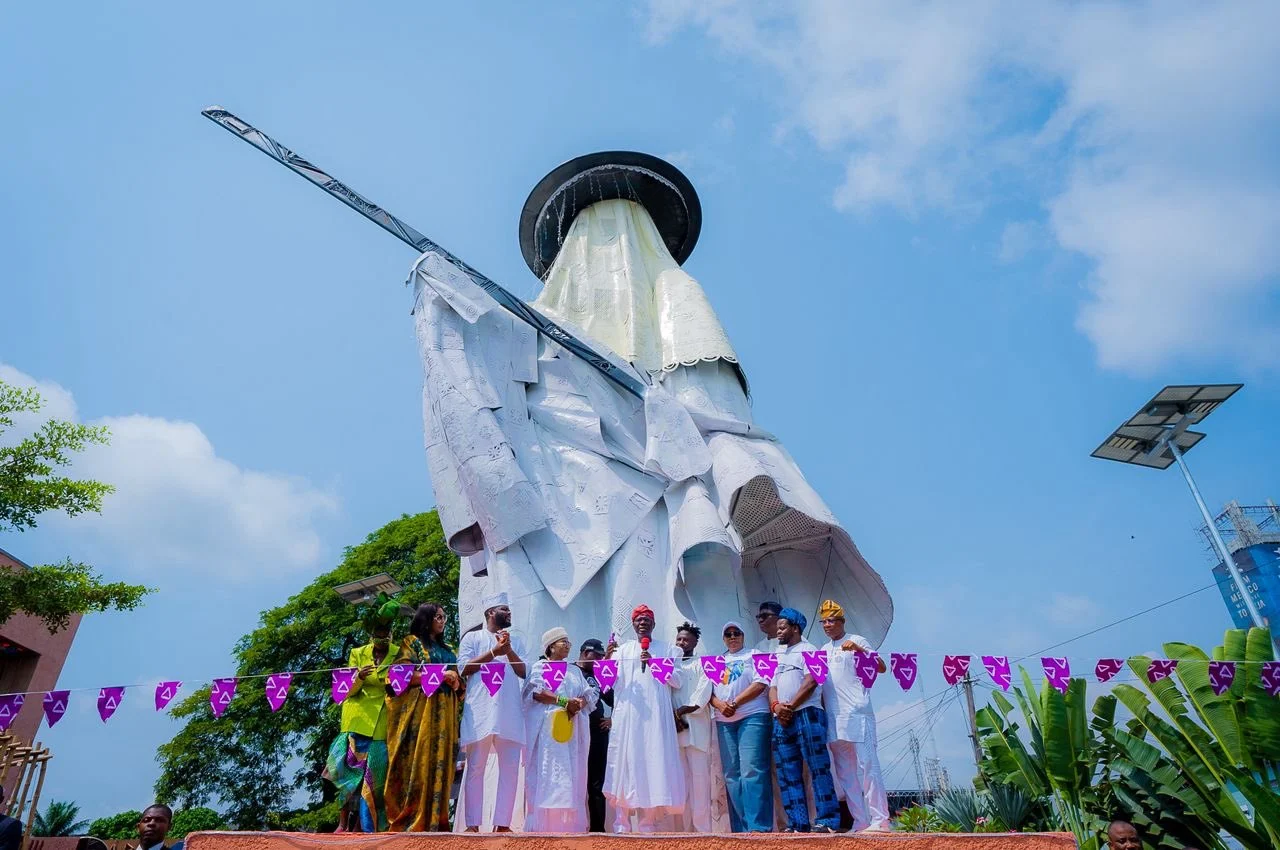


There was no mistaking this for just another public artwork when the white-clad Eyo figure soared over Onikan, over 40 feet into the Lagos skyline. At the John Randle Centre for Yoruba Culture and History, the Lagos State Government unveiled a declaration regarding memory, identity, and the type of global city that Lagos aspires to become.
The Eyo Monument, commissioned by Governor Babajide Sanwo-Olu, comes at a time when cities around the world are rethinking how culture works. It is no longer just heritage to be preserved, but also vital economic infrastructure. For Lagos, Africa’s most populated city and one of its most culturally diverse, the monument represents a conscious effort to make history a live, visitable experience.
Reclaiming Lagos’ Story in Public Space
Eyo transcends the definition of a mere festival. As Lagos’ most identifiable cultural symbol, it is a ritual procession that has its origins before colonial rule. Furthermore, it continues to be intricately linked to the city’s identity. Through the transformation of this symbol into a lasting monument, Lagos is establishing its narrative within a tangible context.
Governor Babajide Sanwo-Olu spoke at the commissioning and described the monument as a narrative device that “tells the story of Lagos to the world.” That framing matters. In an era when global cities fight for attention and tourism dollars, storytelling has become just as vital as infrastructure. The monument is located within the John Randle Centre, a curated cultural hub that includes exhibition galleries, an amphitheatre, and interactive learning spaces. Collectively, they create a cultural ecosystem intended for active engagement rather than passive observation.
Designed to Be Entered, Not Observed
The Eyo building, unlike many public monuments, was designed to be experienced rather than seen from a distance. Visitors can stroll within and move through themed environments that depict Lagos’ cultures, traditions, and rich history.
Dotun Popoola, a curator and artist known for blending metal with social commentary, has described the monument as a “storytelling edifice.” Its form is symbolic, but its purpose is instructional. Each interior room is designed to take visitors through Lagos’ history, from ancient villages to the complex metropolis that it has become. This decision to design internally is intentional. Cultural tourism today feeds on interaction. According to the World Tourism Organization, experiential travel now accounts for more than 60% of global tourist demand. Therefore, Lagos is definitely placing itself amid this global change.
Culture as Economic Strategy
Beyond symbolism, the Eyo Monument is part of a larger tourism strategy. Over the last decade, Lagos has steadily invested in cultural infrastructure. This includes restoring ancient sites and expanding museums and creative areas. The John Randle Centre is crucial to that plan.
CEO Qudus Onikeku has described the monument as both a cultural success and an economic engine. The site is projected to produce sustainable traffic by drawing tourists, researchers, and students. Consequently, this will result in jobs, partnerships, and international prominence. The initiative to create a documentary about the Eyo tradition also aims to broaden the monument’s influence. By transforming it into cultural content that can be disseminated widely, Lagos’ culture is well-positioned for sustained relevance in the global creative economy.
Why This Matters for Lagos’ Global Image
Cities that prosper as tourist destinations typically do one thing well: they own their story. Cultural landmarks work when they feel true and rooted, as evidenced by Bilbao’s Guggenheim effect. In Lagos, the Eyo Monument does not create a new story; instead, it enhances one that is already present. It strengthens the connection between tradition and modernity.
Crucially, teamwork is also evident in the project. It came to fruition through the combined efforts of private stakeholders, public agencies, and traditional institutions. Its validity and longevity are enhanced by the fact that it is owned collectively.
A Living Landmark
Entering, questioning, and experiencing the Eyo Monument is the true purpose of this legacy. As global tourism recovers and travellers seek locations with strong cultural identities, Lagos is making a confident case for itself. The monument is towering, but its true force resides under the surface. It facilitates experiences and delivers the message that Lagos is ready to meet the world on its own cultural terms.
ALSO WATCH MARKETING EDGE ONTV



Comment
No comments found.