
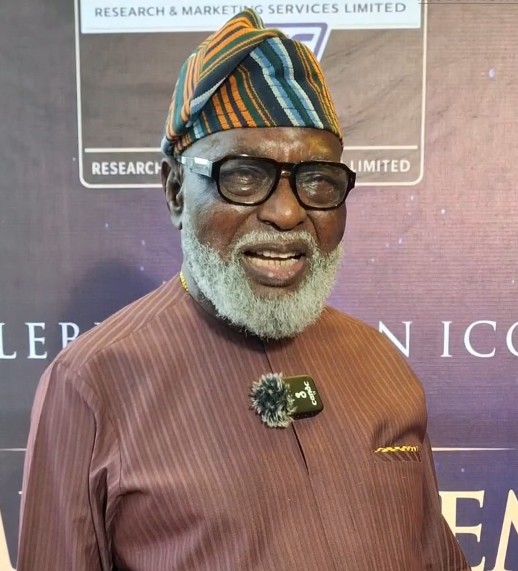


Veteran marketing research expert Kareem Akande Tejumola has emphasised that the future of marketing research in Nigeria remains promising, but professionals must quickly adapt to technological and methodological changes or risk being left behind.
Tejumola, widely regarded in industry circles as the doyen of market research in Nigeria, made this observation while speaking during a gathering organised in his honour by the alumni network of Research and Marketing Services Limited.
The event, which drew industry professionals, former colleagues, and admirers, took place at the Lagos Country Club in Lagos.
Reflecting on the evolution of the research profession, Tejumola noted that the field has undergone significant transformation over the years.
According to him, the approaches and tools that shaped research practice decades ago have gradually given way to more sophisticated and technology-driven techniques.
Consequently, he stressed that the modern research environment now demands deeper analytical skills, stronger technological understanding, and greater adaptability from practitioners.
Speaking candidly about the direction of the industry, Tejumola maintained that marketing research will continue to play an essential role in guiding business decisions and shaping corporate strategies in Nigeria.
However, he warned that professionals who fail to evolve alongside new technologies, particularly artificial intelligence and advanced analytics may find it increasingly difficult to remain competitive.
He explained that the research landscape now relies heavily on advanced tools capable of predicting consumer behaviour, interpreting complex data patterns, and delivering deeper insights into human decision-making.
As a result, research professionals must continually update their knowledge and technical capabilities.
“The future of research is extremely bright,” he said, while simultaneously stressing that adaptation is no longer optional.
In fact, he pointed out that professionals who are merely contemplating change may already be lagging behind the pace of transformation shaping the industry.
Beyond technology, Tejumola also highlighted the importance of talent development in sustaining the growth of marketing research in Nigeria.
He argued that research organisations must prioritise hiring highly skilled professionals rather than relying on inexpensive labour that may lack the required expertise.
According to him, companies that invest in the best talents will ultimately maintain stronger credibility and produce more reliable research outcomes.
He noted that serious research institutions understand that excellence cannot be achieved without assembling teams of capable and well-trained professionals.
Furthermore, he explained that the discipline of marketing research is inherently demanding and requires individuals who possess intellectual curiosity, attention to detail, and an unwavering commitment to accuracy.
For this reason, he insisted that organisations must cultivate environments where professionals continuously learn, refine their skills, and pursue excellence in their work.
At the same time, Tejumola encouraged younger professionals and students to take education and professional development seriously.
He warned that the era when individuals could thrive in the industry without strong academic and technical foundations has effectively passed.
In today’s research-driven economy, he said, knowledge, expertise, and continuous learning now determine professional relevance.
He also addressed the dynamics of talent development within organisations, noting that companies should not assume employees will remain with them indefinitely.
Instead, he advised firms to focus on nurturing professionals who can grow, contribute meaningfully, and later train the next generation of researchers.
According to him, such a cycle of mentorship and professional growth ultimately benefits both organisations and the broader Nigerian economy.
“If we invest in people and allow them to grow, everyone benefits,” he explained, adding that the development of skilled researchers creates long-term value for the industry and the country as a whole.
Despite the rapid changes shaping the profession, Tejumola expressed deep satisfaction with the progress marketing research has made in Nigeria.
He particularly commended the new generation of researchers who have begun embracing modern tools and methodologies to strengthen the industry’s impact.
As the celebratory event drew to a close, he also expressed gratitude for the recognition he received from colleagues, former associates, and industry stakeholders who gathered to honour his contributions to the profession.
Meanwhile, Tejumola reiterated that while the marketing research sector stands on a promising path, its continued success will depend on how quickly practitioners embrace innovation, invest in talent, and maintain the high professional standards required to produce credible insights in an increasingly data-driven world.




Comment
No comments found.