
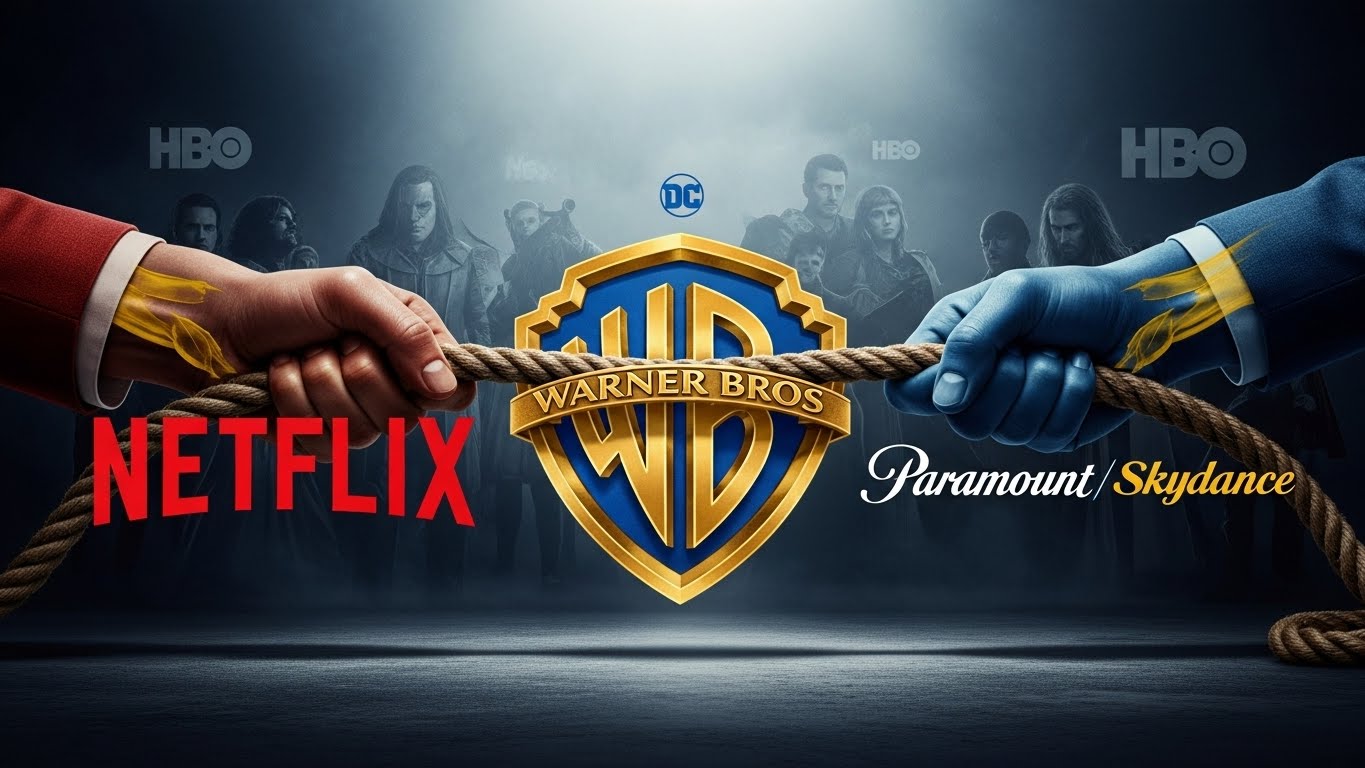


Hollywood has consistently embraced sequels. However, the industry has seldom encountered a narrative as intense as the current situation involving Netflix, Paramount, and Warner Bros Discovery. What started as a modest sale has evolved into a fierce competition. This competition has the potential to alter the landscape of global entertainment. It will decide who influences the future of storytelling for the next century.
Two Bids for a Troubled Empire
The storyline appears straightforward at first glance. Warner Bros Discovery is burdened by debt and a declining cable sector. Consequently, it placed its most valuable assets—its studio and streaming divisions on the market.
Netflix presented a welcoming $72 billion agreement. This blended cash and equity to incorporate Warner’s legendary library into the largest streaming service globally.
But then Paramount Skydance tore up the script.
A hostile takeover attempt was made public to shareholders by the Ellison-backed company on Monday. It offered a total valuation of the Warner Bros Discovery conglomerate exceeding $108 billion. It was the most surprising decision in Hollywood since Disney’s 2019 acquisition of Fox. It angered some studio insiders and astonished pundits alike.
The focus suddenly changed from who will purchase Warner Bros. to something else entirely: What will happen to Hollywood if one of these behemoths comes out on top?
The Battle for HBO
Executives may not openly acknowledge it. Yet, the underlying objective in this competition is HBO.
In a landscape characterised by the predictability of franchises and uncertain cinema economics, the value of prestige storytelling has emerged as a critical factor. It is essential for fostering subscriber loyalty. HBO’s catalogue, encompassing titles such as Succession, House of Dragon, The Sopranos, and The White Lotus, stands unparalleled in the industry.
Acquiring HBO would not only enhance Netflix’s library. It would also reinforce its status as a central figure in the global entertainment landscape. For Paramount, this may represent a critical juncture that determines its continued relevance in the industry.
This is not a merger for rights alone; it’s a bid for control of modern culture.
A Hollywood Model Collapsing in Real Time
This conflict reveals a troubling reality: the conventional business model of Hollywood is disintegrating.
-
Cable revenue is declining.
-
Theatres continue to exhibit volatility.
-
Streaming, initially perceived as a solution, has become costly and demanding.
Warner Bros Discovery has faced significant challenges over the years. These include launching initiatives, merging entities, rebranding efforts, and implementing cost reductions. Despite this, it remains unable to achieve stability. The turbulence presents opportunities for technology-driven disruptors and challengers supported by billionaire funding.
Netflix, previously regarded as an outsider by Hollywood, has now ascended to the status of the establishment. Paramount, once a formidable studio, now grapples with the challenge of maintaining its significance. Warner Bros, renowned for its iconic contributions such as Casablanca and Looney Tunes, now occupies a pivotal position in a larger landscape of corporate consolidation.
Regulators Are the New Studio Bosses
Both agreements encounter significant regulatory examination. The potential merger between Netflix and Warner would establish a formidable entity in the streaming landscape. This would prompt significant apprehensions regarding the implications for creative labor, pricing authority, and the trajectory of cinematic art.
Paramount’s proposal, conversely, may provoke concerns regarding the consolidation of media outlets. This is because CBS and CNN could potentially fall under a singular ownership. Furthermore, there are concerns regarding the company’s political affiliations.
Nevertheless, analysts concur on a single point: regulators currently possess greater influence over Hollywood’s future than any director, studio executive, or producer.
Impact on African and Nigerian Audiences
Africa is one of the world’s most rapidly expanding streaming marketplaces. Thus, this has far-reaching consequences beyond the glitz and glamour of Hollywood.
A slew of streaming services, including Amazon Prime Video, HBO Max, Paramount+, Showmax, and Netflix, have been making rounds across the continent. They are in search of local alliances, original content deals, and loyal subscribers. License rights, competitiveness, and funding for African originals could all be affected by a merger of this magnitude.
Nigeria, with one of the most active film businesses in the world, is currently at a fascinating crossroads. A shift toward premium worldwide distribution pipelines might be in store for Nollywood if Netflix emerges victorious. Paramount may need to aggressively expand locally if it wins to justify the magnitude of the acquisition. This might lead to new opportunities for investors, producers, and creatives.
In any case, Africa emerges as a pivotal arena in the aftermath of the merger.
A Hollywood Century Turning Its Final Page
What makes this moment remarkable is not the size of the bids, which are amazing. It is the symbolism.
For decades, Hollywood has defined storytelling. Silicon Valley money, wealthy families, and platform economics now define Hollywood. Power is changing from studios to streaming services, from directors to analytics, and from long-term artistic aspirations to billion-dollar subscription fights.
The conflict between Netflix and Paramount regarding Warner Bros transcends a mere corporate transaction. It serves as the definitive evidence that the bygone era of Hollywood has concluded. It gives way to a new age that is increasingly ruthless, globally oriented, and heavily influenced by algorithms.
The entertainment industry’s narrative will change irrevocably regardless of what occurs next.
ALSO WATCH MARKETING EDGE ONTV



Comment
No comments found.