


Over the past decade, corporations have increased their advertising volumes. They also strengthened their algorithms and doubled down on performance marketing in a race to capture consumer attention. At some point, the market caught up. Consumers did not only adapt; in fact, they became more demanding. Modern audiences skim promotional messages with the precision of a military exercise. They have seen everything, from clever gimmicks to seasonal sales and well-rehearsed “we care” campaigns.
Amid this fatigue, one truth stands out: empathy. It functions not as a buzzword or a corporate social responsibility tactic, but as a core business strategy.
Today, brands that win are the ones that connect emotionally. They put human needs before profit. They also understand their customers’ realities. Furthermore, they solve real problems before they create products, services, or campaigns. In the current branding landscape, empathy has quietly become the most powerful competitive advantage.
Why Empathy is a Strategic Advantage
Marketers around the world have observed a shift in consumer mentality. Long before economic pressures, inflation, and digital exhaustion intensified, audiences had already begun withdrawing from brands that felt out of touch.
A 2024 Deloitte Consumer Pulse study found that 72% of customers prefer brands that understand their emotional context, not just their wants. Forget demographic charts and surface-level psychographics. Instead, consumers now value context, nuance, and an understanding of their lived experience.
This shift is even more pronounced in Nigeria. Consumers face financial strain, digital fatigue, and a barrage of low-quality communication. Trust is no longer earned by volume. Rather, it is earned by brands that communicate with understanding. As a result, empathy in service, product design, messaging, and community support has become a critical driver of loyalty.
The Structural Mandate
Empathy is not only emotional; it is structural. It now shapes how brands develop products, communicate, respond in crises, and resolve public conflict.
Modern brands understand that goodwill does not come from marketing alone. It comes from behaviour, consistency, and emotional intelligence. Specifically, it comes from brands that do the simple things well: solving problems quickly, keeping promises, communicating with clarity, and creating tools that help rather than distract.
Goodwill forms naturally when empathy guides action.
Empathy Becomes an Economic Engine
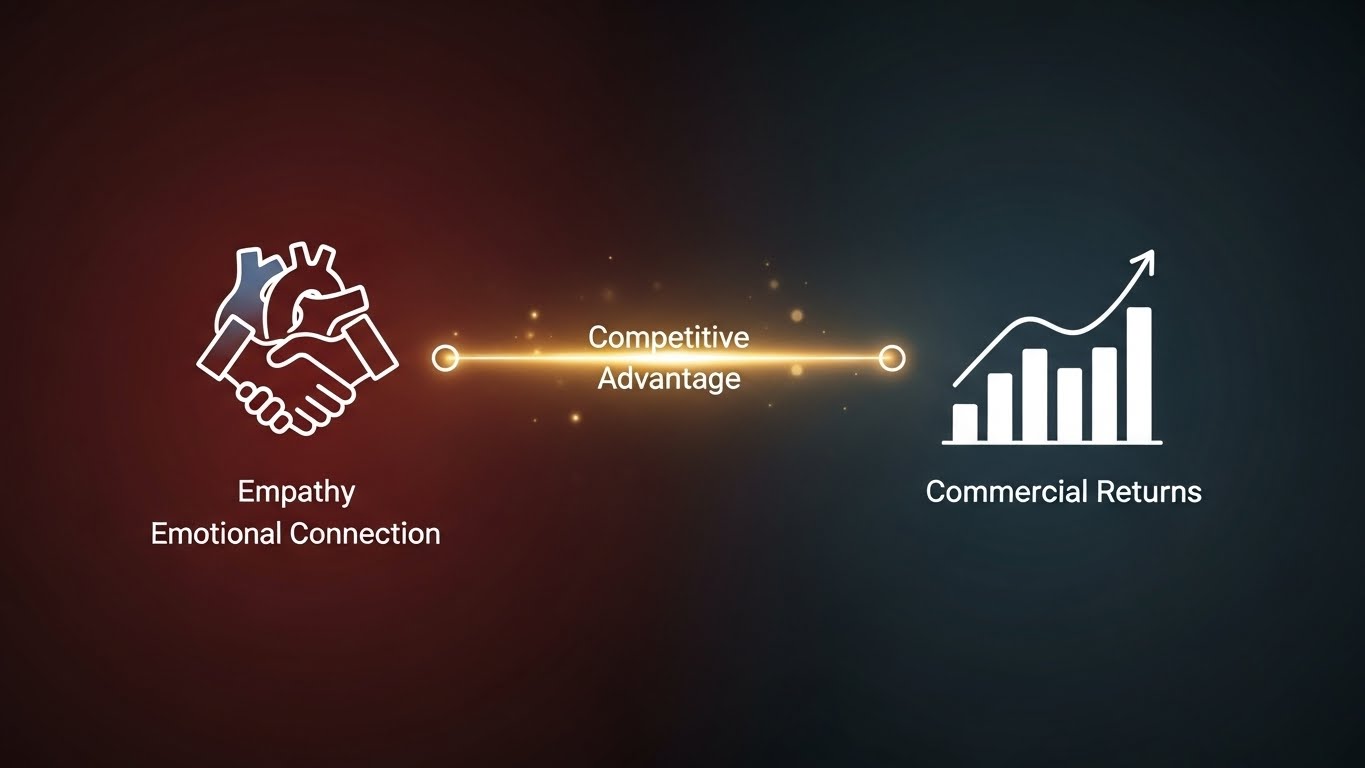
Many still view empathy as soft, idealistic, or vague. Yet, behavioural economics has repeatedly shown that empathy drives commercial returns.
-
Harvard Business Review calls empathetic design “the closest thing to a competitive moat.”
-
Forrester’s CX Index directly links emotional connection to long-term revenue.
-
Brand tracking studies across Africa, Europe, and the Middle East show that emotionally intelligent brands outperform transactional ones in retention, referrals, and repeat purchases.
Friction is expensive, and empathy reduces friction. Trust is scarce, and empathy builds trust. Brands compete for memory, and empathy strengthens recall. Ultimately, when consumers trust a brand, it spends less on persuasion.
The Emotional Layer of Brand Strategy
Empathy is not a personality trait for brands. Instead, it is a strategic lens that influences everything else.
It shapes product innovation. Companies like Paystack, Apple, and Tesla win not because they are the cheapest or the loudest, but because they simplify complex, frustrating experiences. They make life easier. They treat users with dignity. They respect their time. That is empathy as user experience.
It shapes communication. The most successful campaigns in recent years were not the flashiest. They were the most emotionally intelligent. They acknowledged economic realities, addressed social issues with nuance, and used language grounded in everyday life instead of corporate abstraction.
It shapes crisis response. Consumers rarely remember the original mistake. They remember how fast the brand responded, how honest the apology was, and how well the brand understood their feelings.
Empathy often decides whether a brand survives or collapses under scrutiny.
Empathy Cannot Be Automated
Brands need a deeper view of people, not just their performance. Audiences are not “segments,” “funnels,” or “targets.” Rather, they are humans with anxieties, time pressures, cultural expectations, and emotional cycles.
This is where many brands struggle. They speak at scale but listen without depth. They collect data but ignore meaning. They chase attention but fail to build connection.
The brands that lead the future will see empathy as a discipline grounded in research, observation, humility, and responsiveness.
AI can personalize and predict. It cannot feel. Emotional intelligence remains one of the last true competitive edges in an automated world. Consumers can detect when a brand is trying too hard, and they know when empathy is genuine.
Authentic empathy is not:
-
Performance messaging
-
Trend-driven campaigns
-
Sentimental writing
-
A humanized hashtag
Instead, real empathy is grounded in service, clarity, honesty, and respect for people’s time, intelligence, and emotional reality.
The final truth: Goodwill is no longer something brands can buy. They must earn it slowly, consistently, and with real intention.
Empathy is the strategy.
Everything else is execution.
ALSO WATCH MARKETING EDGE ONTV




Comment
No comments found.